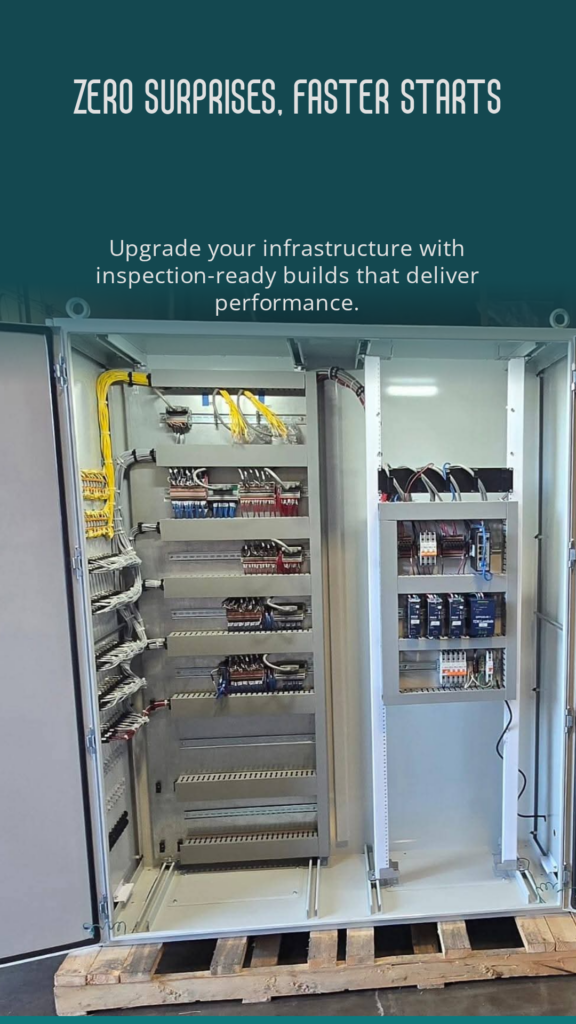
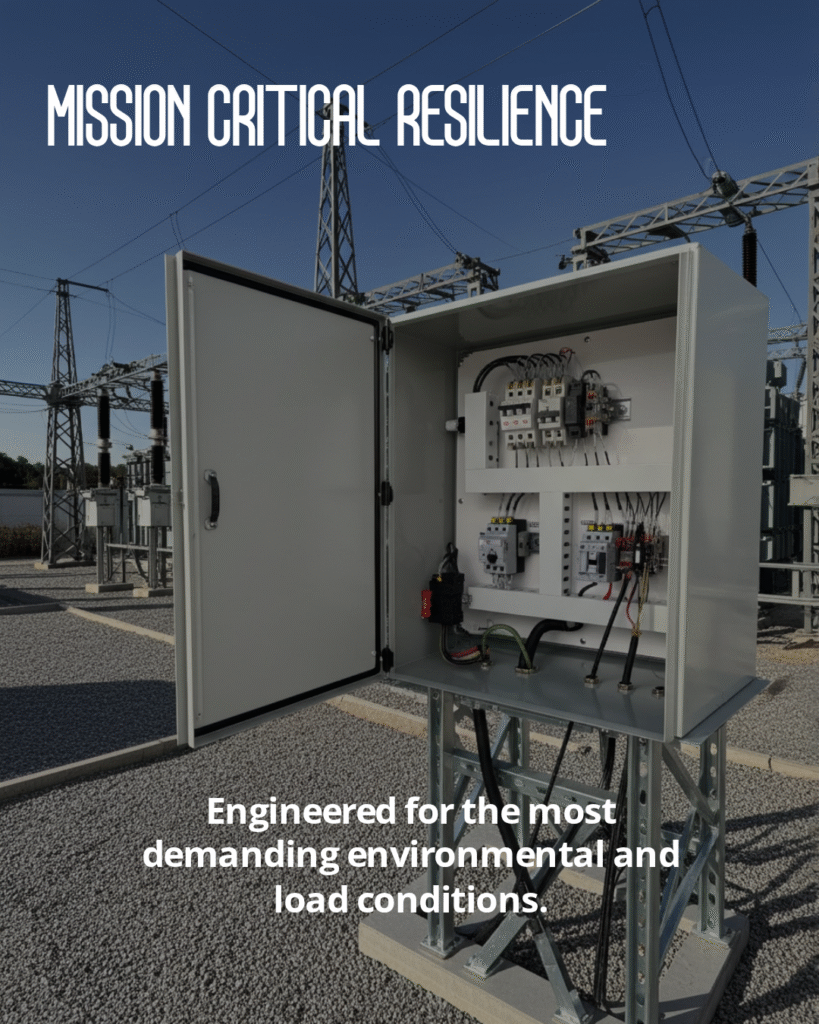
By Rock Grbic, Director of Engineering, Applied Gray Matter — UL 508A MTR, NFPA 70, IPC J-STD-001 certified. Serving Fortune 500 OEMs, hyperscale data-center developers, and mission-critical industrial operators nationwide.
Why I’m writing this
Every few weeks I get a phone call that starts the same way. “Rock, we bought a panel from another shop. It passed FAT. It shipped. We installed it. And now, at 3 a.m. on the second night of commissioning, our synchronizing relay won’t close the tie breaker, the PLC is throwing an F0116 major fault, and the arc-flash label on the door says ‘15.6 cal/cm² at 18 inches’ but nobody on my crew has category 3 PPE on site. Can you get on a plane?”
I’ve been getting that call for more than twenty years. Different plants, different states, different industries — aerospace test cells, protein-processing lines, EV battery gigafactories, oil and gas ESD skids, hospital emergency-power galleries, and now, more than anything else, hyperscale data centers rising out of the Virginia clay, the Phoenix caliche, the Ohio farmland, and the Nevada high desert. The panels are different. The failure mode is always the same. Somewhere in the first forty hours of engineering, a shortcut was taken. Somebody didn’t run the modified-method SCCR calculation. Somebody bundled twelve THHN conductors in a wireway and never applied NEC Table 310.15(B)(3)(a) derating. Somebody special a Class CC fuse against a component with a 10 kA short-circuit current rating and hung a “65 kA SCCR” sticker on the panel door anyway. The panel worked in the shop. It fails in the field. And by the time I’m on the plane, the customer has already lost eight figures of revenue on a commissioning delay that never should have happened.
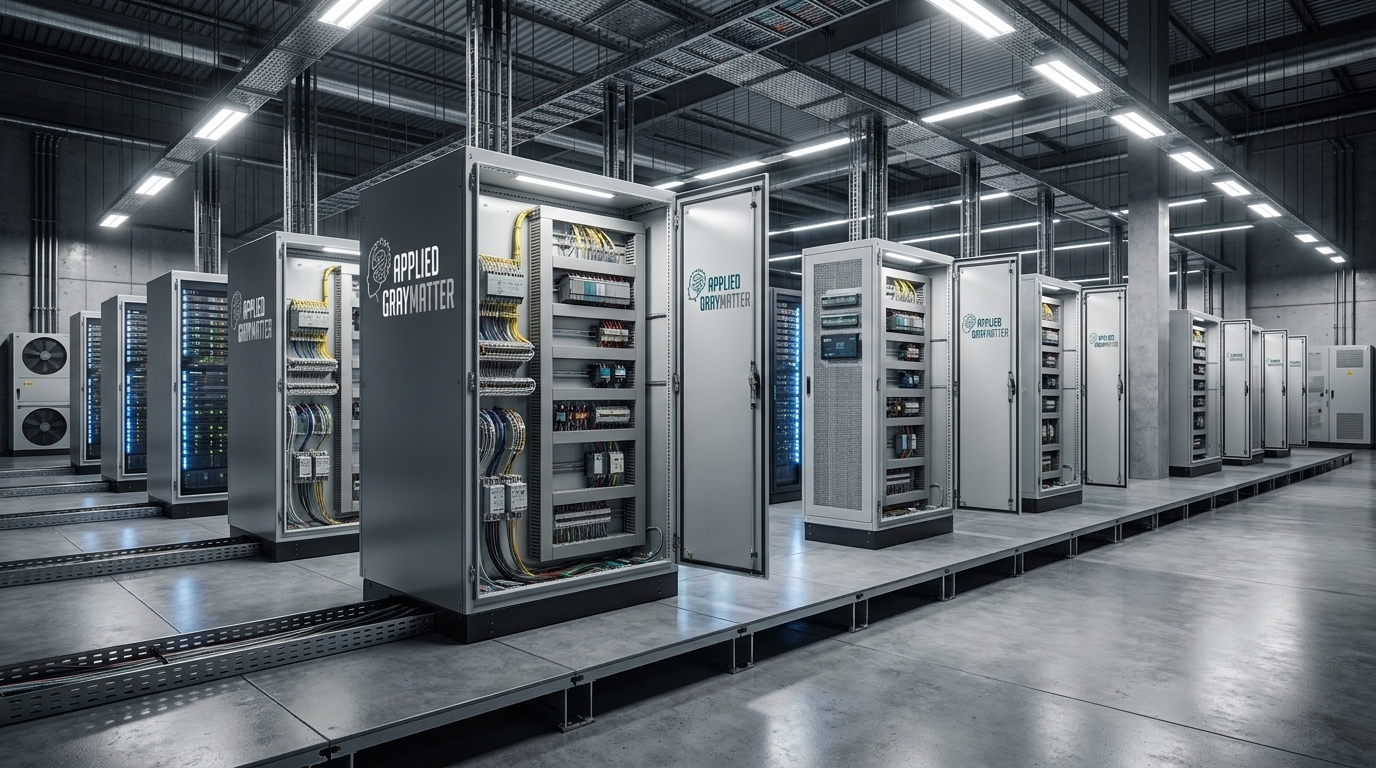
AppliedGrayMatter.com Engineers Control Panels For Data Centers and AI Data Centers According To Your Specifications & Requirements. Call Us At (315) 878-2372
This guide exists because the control panel is the single most misunderstood, most under-engineered, most commoditized piece of equipment in the modern industrial and mission-critical facility, and the cost of getting it wrong is going up — not down — every year. AI training build outs have compressed data-center schedules from thirty months to eighteen. EV battery plants are permitting faster than their utility interconnections can be studied. Pharmaceutical clients are validating GMP process lines under FDA timelines that treat every day of slippage as a $500K erosion of commercial exclusivity. The panel is on the critical path of all of it. If you are the person responsible for sourcing that panel — a plant electrical engineer, a data-center EPC PM, an OEM machine builder, a facilities director, a Fortune 500 procurement lead — this article is for you. By the end of it you’ll have the vocabulary, the compliance framework, the cost-versus-risk logic, and a very specific sourcing checklist. And you’ll know exactly why Applied Gray Matter is the shop that gets the 3 a.m. phone call — and why it should have been building your panel from the beginning.
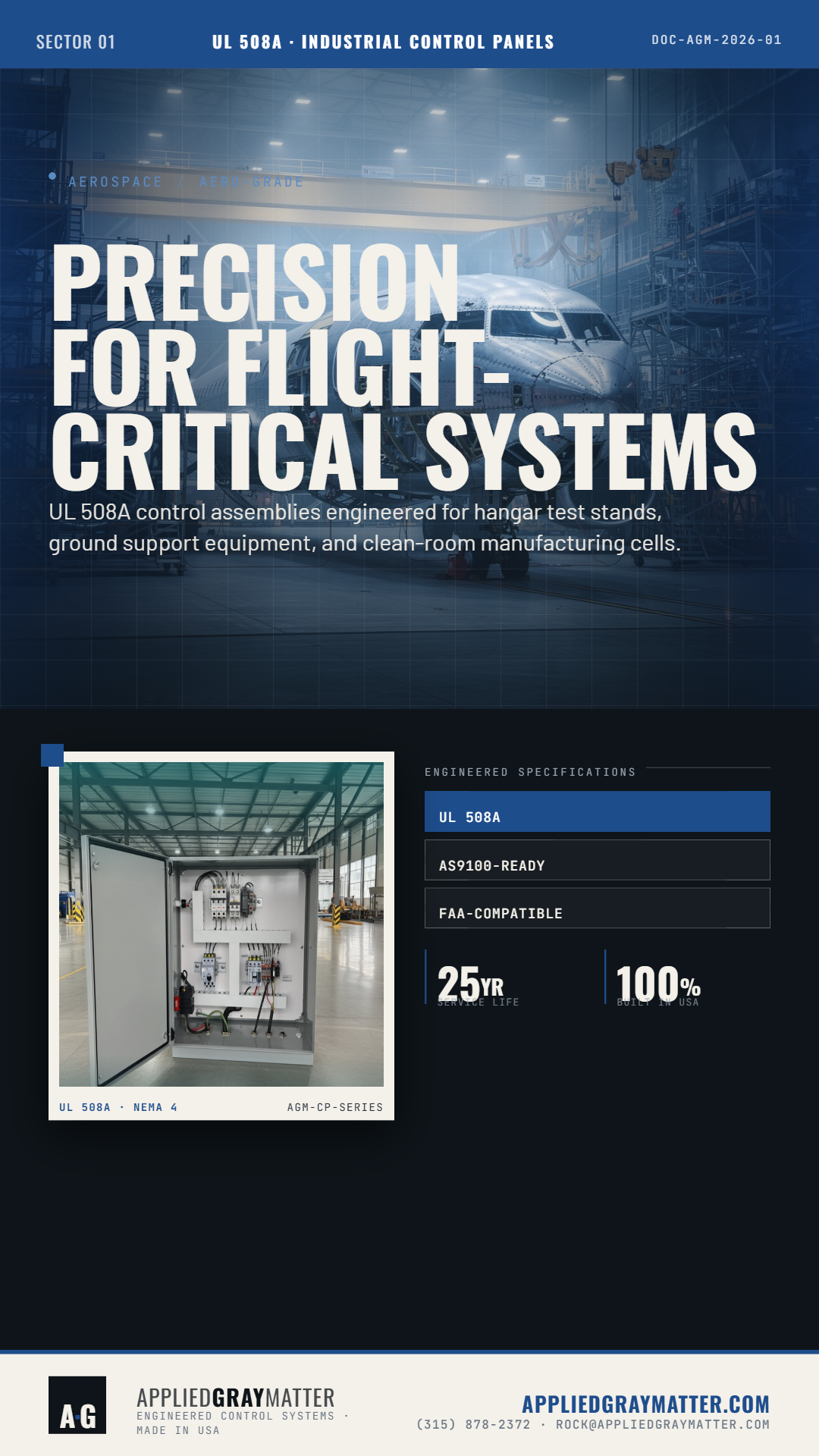
At Applied Gray Matter, we engineer UL 508A control assemblies for hangar test stands, ground support equipment, and clean-room manufacturing cells. Every panel is built to spec by certified UL 508A technicians, with NEC and NFPA 79 compliance in mind.
What an industrial control panel actually is (and why the name matters)
Walk any industrial site with me and you’ll hear the same physical assembly called by seven different names, depending on who’s talking. The maintenance electrician calls it the “control cabinet.” The instrumentation tech calls it the “PLC panel.” The consulting engineer’s specification section calls it the “process control panel.” The purchasing agent calls it the “electrical enclosure.” The plant manager calls it “that box over there that keeps tripping.” The manufacturer’s cut sheet calls it an “automation enclosure.” The UL inspector calls it an Industrial Control Panel, or ICP, and treats every word of UL 508A as if the safety of your workforce depended on it — because it does.
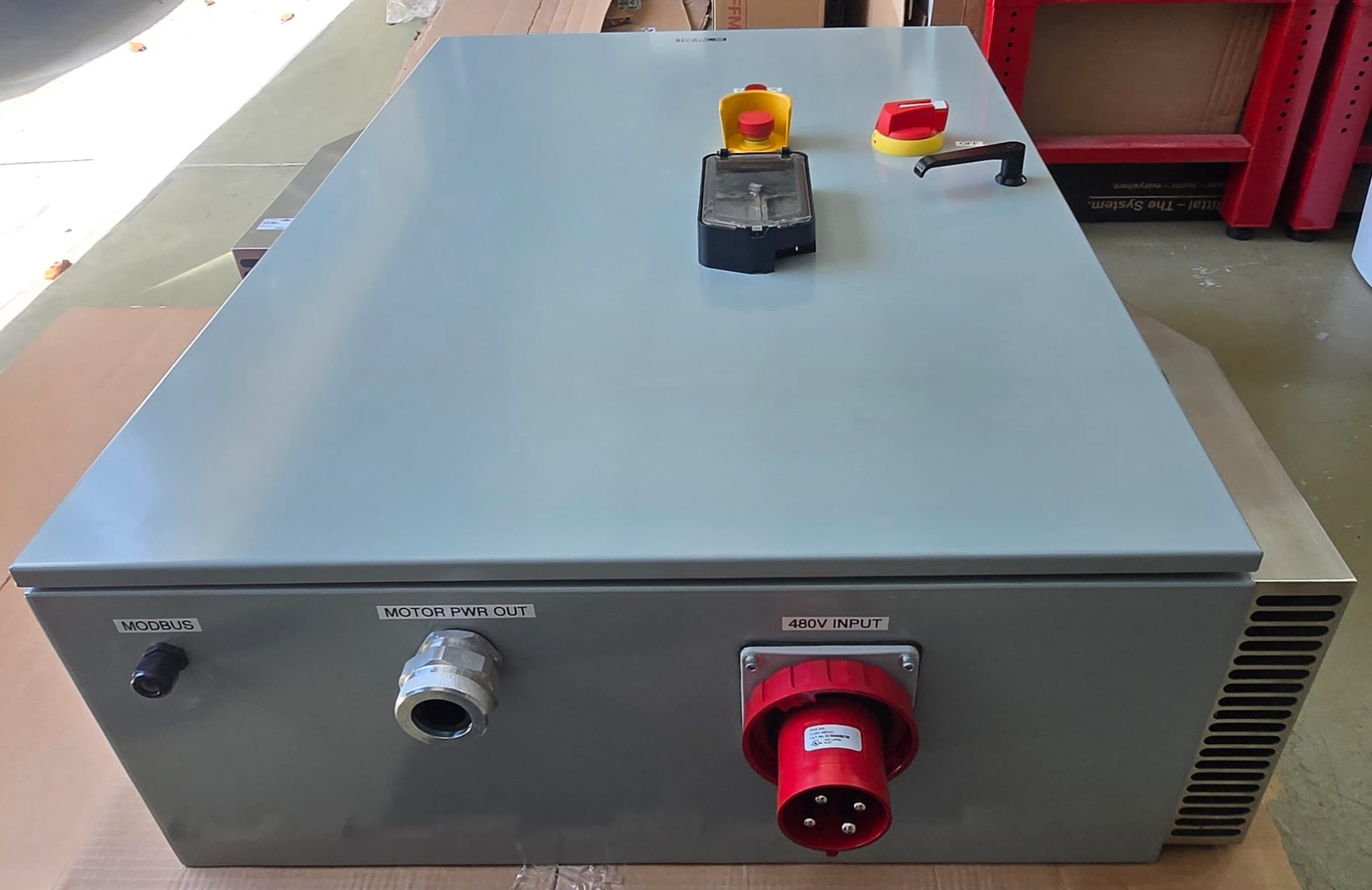
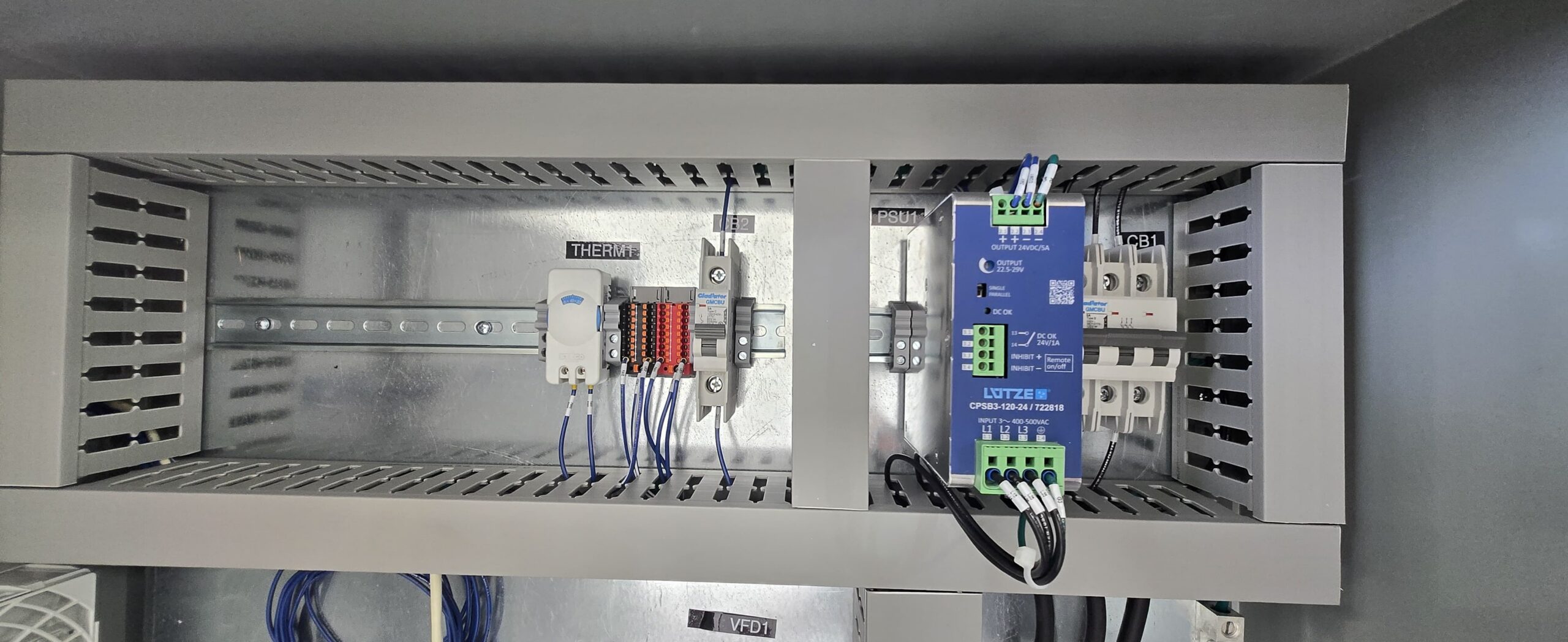
UL 508A Control Panels Built and Certified By ApliedGrayMatter.com
This naming ambiguity matters more than it seems. When your consulting engineer specifies a “PLC panel with 32 discrete inputs, 16 discrete outputs, and 8 analog inputs, in a NEMA 12 enclosure, with a 24 VDC control supply,” they have said almost nothing about the panel’s safety, compliance, ratings, cybersecurity posture, or maintainability. That specification is a functional description of the automation payload. It is not an engineering specification for the panel itself. The engineering specification lives inside UL 508A, NEC Article 409, NFPA 79, and — if the equipment is being exported — the European Low Voltage Directive 2014/35/EU and EMC Directive 2014/30/EU. If your panel shop doesn’t push back on a thin functional spec with a real engineering questionnaire — available fault current, ambient temperature, altitude, corrosion class, seismic zone, network security posture, redundancy requirements — you are not working with an engineering partner. You are working with an order-taker, and the moment your panel touches real infrastructure, the deficiencies of that spec become the plant’s problem.
At AGM we start every project by rewriting the spec. Not to be difficult. Because the difference between “a PLC panel in a NEMA 12 enclosure” and “a UL 508A-labeled industrial control panel with a documented 65 kA modified-method SCCR, NEMA 12 stainless enclosure with 65°C ambient rating and vortex cooling sized to 340 watts of internal dissipation, dual redundant 24 VDC supplies with diode ORing, an IEC 62443-4-2 Security Level 2 network posture, and a stamped IEEE 1584 incident-energy label reading 3.8 cal/cm² at 18 inches” is the difference between a panel that lives twenty years in your facility and a panel that fails commissioning.
The seven engineering decisions that separate a great panel from a liability
Every panel I’ve ever seen fail — every single one — traces back to at least one of seven engineering decisions that were made poorly, made late, or not made at all. If you’re evaluating a panel shop, ask them how they handle each of these. The answers will tell you more than any brochure.
Decision one: Short-Circuit Current Rating
UL 508A Supplement SB is where the industry hides its worst work. The Short-Circuit Current Rating, or SCCR, is the maximum prospective fault current a panel can safely withstand at its supply terminals. Under NEC Article 409.110, that rating must be marked on the panel nameplate, and under 409.22 the panel cannot be installed on any electrical system with an available fault current higher than its SCCR. Sounds simple. It is anything but.
The default SCCR of a panel is the lowest SCCR of any component in its power path — and most industrial components ship with default SCCRs of just 5 kA. Class CC fuses at 5 kA. Small motor controllers at 5 kA. Terminal blocks at 10 kA. Meanwhile, your utility service at a 500-horsepower motor branch is routinely 42 kA, 65 kA, or higher. A 5 kA-rated panel installed on a 42 kA service is not just non-compliant. It is a mechanism for the panel to fail catastrophically — enclosure rupture, molten copper ejection, arc-blast pressure wave — the first time a fault occurs downstream of it.
The way you get from 5 kA to 65 kA is the modified method under UL 508A Supplement SB4. It is an itemized, current-limiting-fuse-and-breaker-coordinated analysis that considers every component in the power path, every let-through current, every peak-let-through table, every I²t rating, every combination motor controller assembly, and every unfused branch. It is engineering work. It is not a checkbox. Most shops don’t do it. AGM does it on every single panel, delivers the calculation as a signed, dated PDF with the drawing package, and stamps the panel nameplate with a rating we can defend to any AHJ, any UL field engineer, and any insurance adjuster who ever asks. On a typical data-center switchgear or manufacturing MCC panel our routine target is 65 kA SCCR, and for hyperscale generator paralleling gear we go to 100 kA using series-rated combinations we’ve qualified in advance.

https://appliedgraymatter.com/services/ul-508a-control-panel-fabrication-shop/
Decision two: Conductor ampacity, bundling, and derating
You would be astonished how many panels I’ve opened in the field where the shop routed twelve or fifteen current-carrying THHN conductors through the same wireway and speced them at the standard 90°C table ampacity. Under NEC Table 310.15(B)(3)(a), once you exceed nine current-carrying conductors in a raceway or bundle, you apply a 50% derating factor. Ten conductors of #14 THHN rated at 25 A each are not carrying 25 A. They are carrying 12.5 A each, and the moment your process pulls 20 A across one of them, the insulation cooks, the wireway browns, and eventually you have a bolted fault inside your control panel.
AGM engineers separate wireways for power circuits, control circuits, low-voltage DC, and Ethernet by default. We derate conductors in the drawing package using the actual bundling density we intend to build. We specify 105°C or 125°C rated conductors in high-density regions instead of relying on ampacity headroom that isn’t there. And we photograph the finished wireways during factory acceptance testing so your consulting engineer has documentary evidence that the as-built matches the drawing.
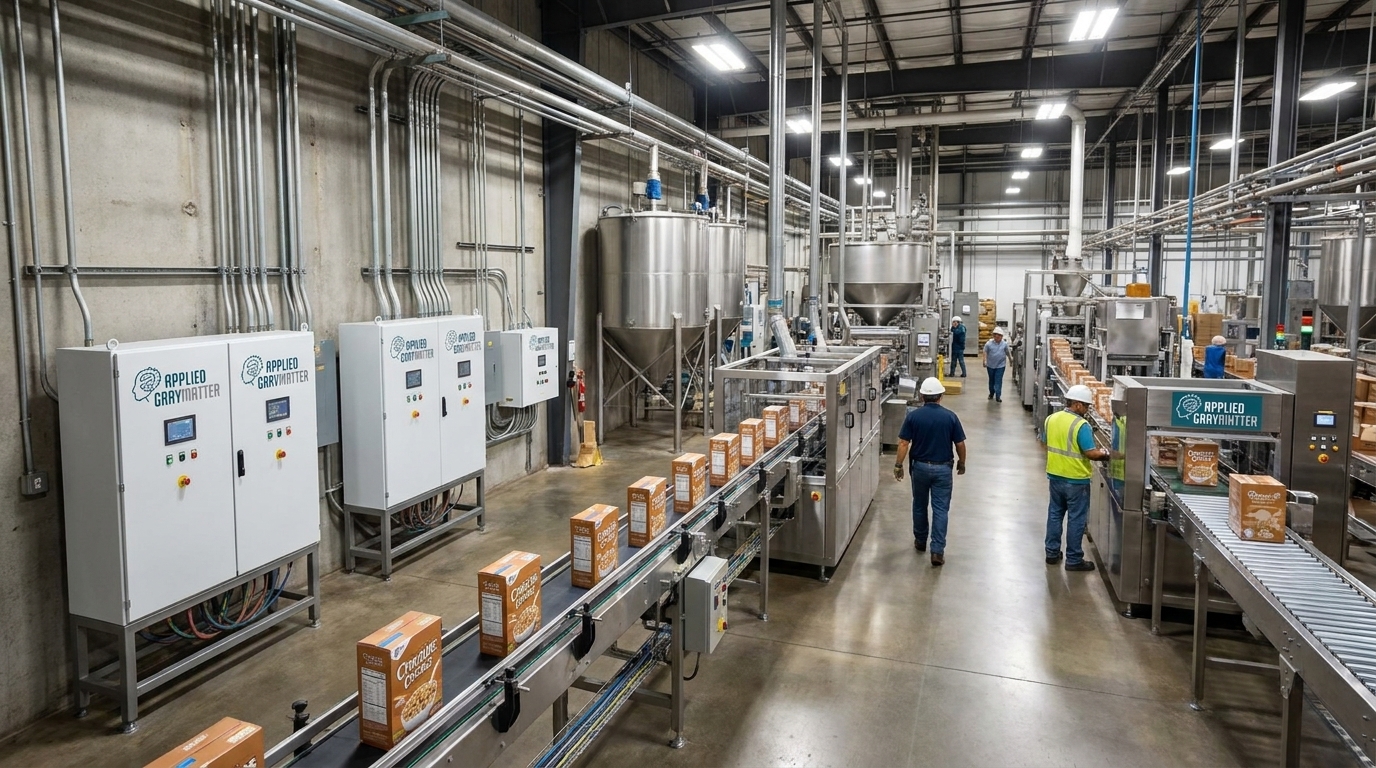
Decision three: Arc-flash calculation and PPE labeling
NFPA 70E requires every energized electrical panel over 240 V to carry an incident-energy label documenting the arc-flash boundary, the incident energy at the working distance, the site-specific PPE category, and the date of the study. In practice, most panel shops ship panels with no label at all, or with a generic “Warning — Arc Flash and Shock Hazard” sticker that carries zero engineering weight. The customer then has to hire a separate consulting firm at $15,000 to $40,000 per project to run the IEEE 1584 study, coordinate the upstream protective device settings, and print and affix the labels — a service that could and should have been part of the panel build.
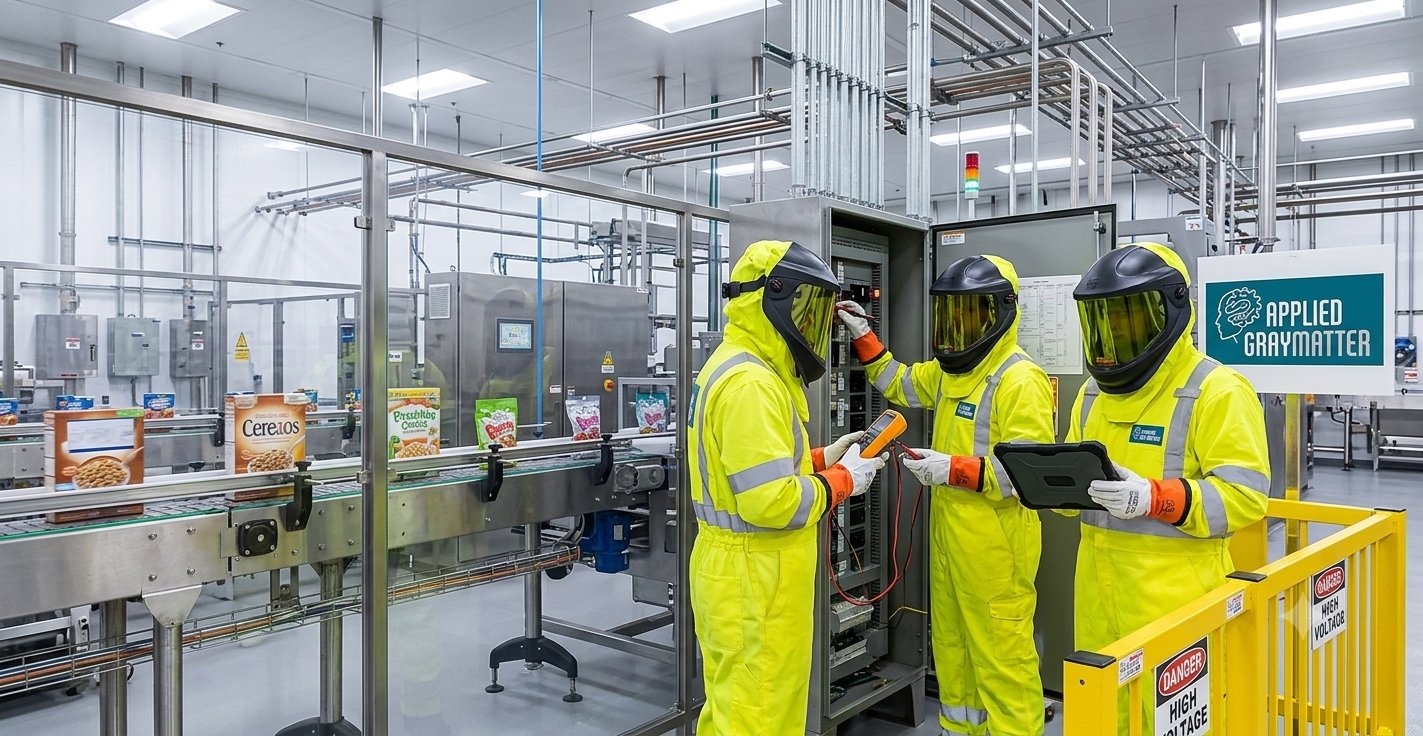
ARC Flash Services The foundation of any electrical safety program is the identification of the hazards. It is the employers responsibility to comply with the law and complete an electrical safety assessment. These mandates can be found in the current OSHA regulations.
AGM performs the IEEE 1584-2018 incident-energy calculation as part of every panel build for which the customer provides upstream protective device data. We deliver the panel with the calculated arc-flash boundary, working-distance incident energy in cal/cm², required PPE category (Cat 1 through Cat 4 or “Dangerous — No Live Work”), and the AHJ-acceptable label already affixed to the panel door. On data-center and mission-critical projects we go further: we deliver the ETAP or SKM model file itself so your facility’s electrical engineering team can maintain the model as the site evolves. You are not just buying a panel from us. You are buying the documentary infrastructure that lets your electrical safety program stay compliant for the life of the facility.

PCB (Printed Circuit Board) Design and Manufacturing
Decision four: Segregation of intrinsically safe and hazardous location circuits
Any panel that touches a Class I, Division 1 or Division 2 environment — oil and gas separators, ethanol plants, grain-handling operations, hydrogen storage rooms, pharmaceutical solvent-recovery loops, lithium electrode coating lines — has to segregate intrinsically safe wiring from all other circuits under NEC Articles 500 and 504. Blue-jacketed IS wiring must be physically separated from line-voltage circuits by a minimum two-inch air gap or a grounded metallic barrier. IS ground bars must be isolated from equipment ground bars. IS terminal blocks must be light blue, physically discriminable, and lockable-out from ordinary circuits. Under IECEx and ATEX for export, the barrier count, the entity parameters (Voc, Isc, Ca, La), and the loop resistance calculations must all appear in the ex-documentation package.
I’ve walked into panels built by shops that did none of this. They had 120 VAC control circuits running two inches from 24 VDC IS solenoid loops, no barrier, no segregation, blue and black wiring commingled in the same wireway. The panels were labeled “Class I, Div 2 compliant” on the doors. They were not. They were dangerous, they were non-compliant, and if the AHJ had inspected them properly they would have been red-tagged on the first walkdown. AGM’s oil-and-gas and pharmaceutical control panels segregate IS from non-IS at the layout stage — before the first hole is punched in the sub-panel — and the drawing package documents the segregation for the customer’s operational safety file.
Decision five: Thermal management inside the enclosure
The lifetime of every electrolytic capacitor in your variable frequency drive is governed by the Arrhenius equation: every 10°C rise in operating temperature roughly halves the useful life. A VFD rated for 40°C ambient, installed inside a NEMA 12 sealed enclosure with 800 watts of internal dissipation, no cooling, and a 35°C ambient outside the panel, will see internal temperatures of 60°C or higher. Its 10-year capacitor life becomes a 2.5-year life. The drive fails. The line stops. The customer blames the drive manufacturer. The drive manufacturer looks at the derating and points at the panel shop.
AGM’s engineering process computes the total internal heat load using the actual UL heat-loss data for every component — PLC power supply, VFDs, contactor coils, transformers, control transformers, DC power supplies — sums it under worst-case duty, and specifies cooling to hold the enclosure internal temperature at least 10°C below the lowest-rated component’s derating point. For low dissipation we use passive convection. For medium loads we use filtered forced-air with washable HEPA filters and pressure-differential switches on the intakes. For high dissipation in dirty environments we use closed-loop air-to-air heat exchangers or Peltier coolers. For data-center row-level panels sitting in a cold aisle we specifically avoid vent-and-fan designs because the panel exhaust would push hot air into the cold aisle and violate the customer’s containment strategy — instead we use sealed NEMA 12 enclosures with thermosiphon cooling that dumps heat to the enclosure surface at very low temperature rise.
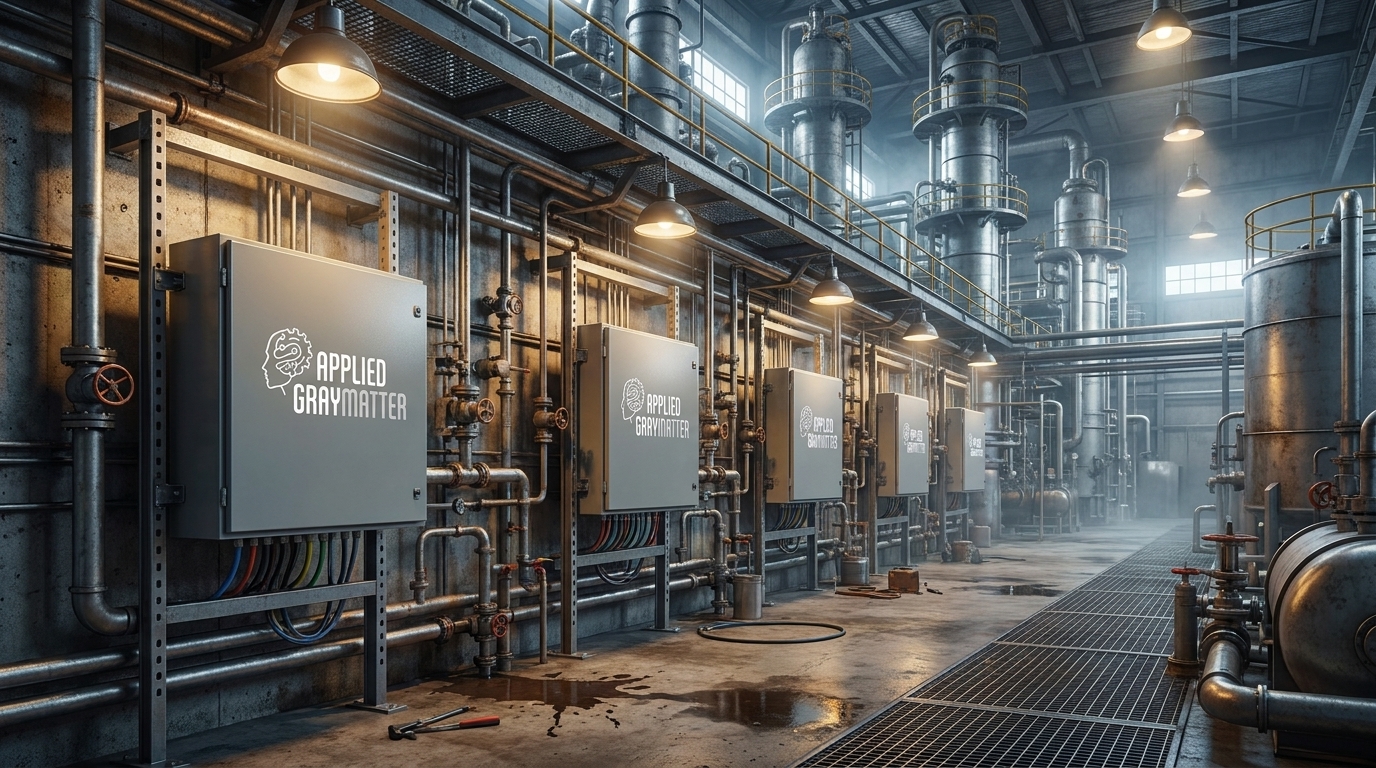
Decision six: Cybersecurity of the control layer
This is the decision that has separated top-tier shops from commodity shops in the last three years and will separate them even more decisively in the next three. Every modern PLC — Rockwell ControlLogix, Siemens S7-1500, Beckhoff TwinCAT 3, Mitsubishi iQ-R, Omron NX/NJ — sits on an OT network that is, in practice, increasingly bridged to the corporate IT network for data historian, MES integration, remote support, and cloud analytics. That bridge is a vector. Colonial Pipeline was compromised through an OT-adjacent VPN. Norsk Hydro lost $75 million to LockerGoga malware that jumped from IT to OT. The 2021 Oldsmar, Florida water-treatment intrusion — where an attacker tried to raise the sodium hydroxide concentration to lethal levels — happened through a poorly secured HMI on a control panel.
AGM builds every network-connected panel to IEC 62443-4-2 Security Level 2 as a baseline. That means hardened managed switches (Cisco IE, Moxa EDS, Hirschmann RSPE) with unused ports administratively disabled and MAC-address-based port security enabled, VLAN segmentation between the control network and any bridged management network, factory-default passwords eliminated on every device, TLS-encrypted engineering access to the PLC, and where the customer’s threat model requires it, an in-panel industrial firewall or diode-based data-diode gateway that physically prevents inbound traffic. We document the security posture in a Cybersecurity Design Basis document that becomes part of the drawing package. Your CISO will ask for it eventually. We give it to you before they ask.
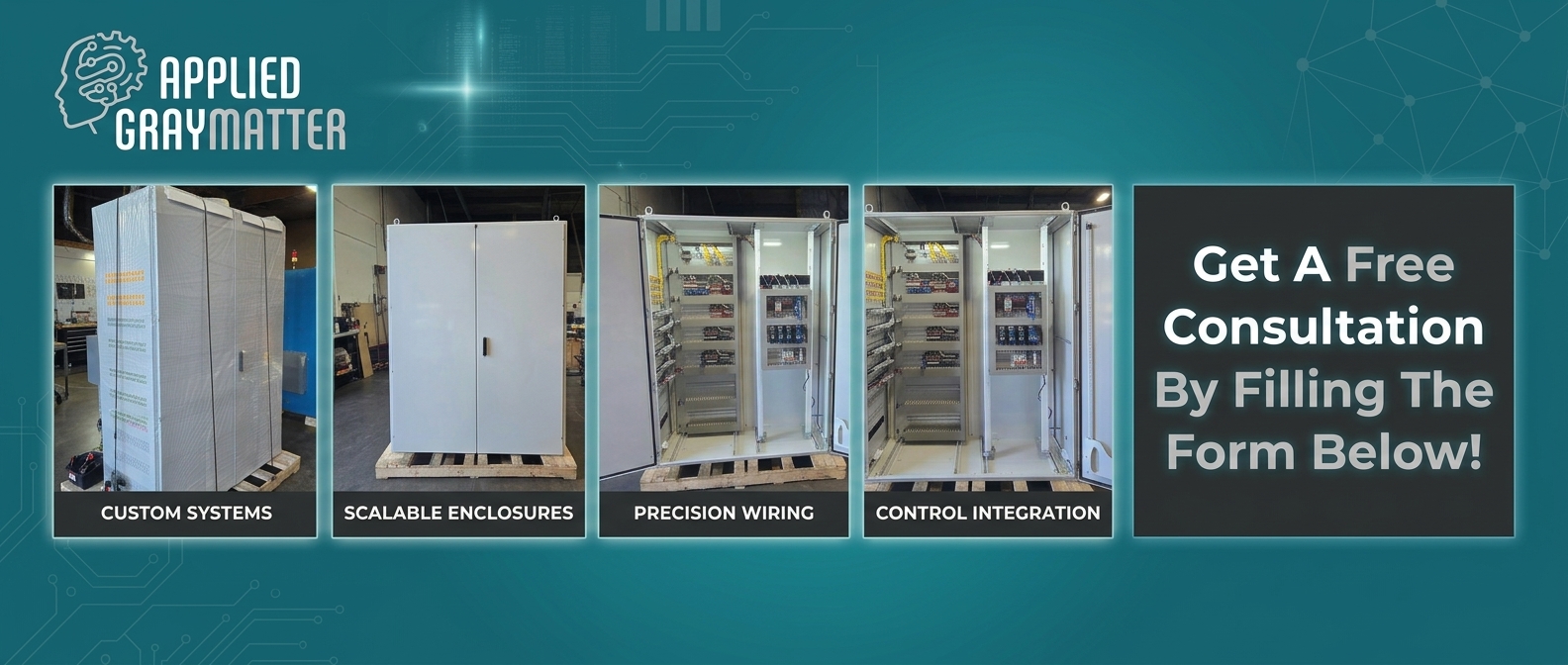
Contact Us – Applied Gray Matter UL508A Control Panel Fabrication Shop. Fill in the form below. Call Us (315) 878-2372
Decision seven: Documentation you can actually maintain
I’ve said it for twenty years and I’ll say it again: a panel shop that ships you flat PDF prints and no editable AutoCAD Electrical or EPLAN project files is holding your infrastructure hostage. Five years from now, when your process changes and you need to add four discrete inputs and two analog outputs, your integrator will need the source files. If they don’t have them, they will either reverse-engineer them at your expense — a $30,000 to $60,000 exercise on a moderately complex panel — or they will rip and replace the panel entirely at your much greater expense. Either way, you are paying twice for the same panel.
Every AGM panel ships with the native AutoCAD Electrical or EPLAN project files, an Excel bill of materials with line-level manufacturer part numbers and current pricing, the ladder-logic source code for the PLC in its native project format, the HMI runtime project, the network topology diagram, the arc-flash and SCCR calculations, the CE technical file if applicable, and a photograph package documenting the as-built condition. We deliver it on a USB drive at Factory Acceptance Test. We also deliver it to a customer-specified cloud location. When your integrator calls us five years from now asking for the drawings, we still have them. They’re your files. They stay yours.
What UL 508A actually certifies (and what it doesn’t)
Almost every panel shop’s website claims to be “UL 508A certified.” Almost none of them explain what that certification does and does not mean, and the difference matters when you’re evaluating suppliers.
UL 508A is not a design certification. It does not certify that any particular panel is safe. It is a manufacturing program certification. It certifies that a specific shop, at a specific address, with specific trained personnel and a specific quality management system, is authorized by UL to apply the UL listing mark to a panel that the shop has built to the UL 508A standard. The shop is inspected quarterly by UL. The shop must maintain at least one Manufacturer’s Trained Representative, or MTR, who has passed UL’s examination on the standard. AGM maintains multiple MTRs, including me personally. The shop must build the panel using components that are themselves UL Listed or UL Recognized under the appropriate categories. The shop must maintain drawing control, revision history, and a formal engineering approval process. If any of these break down, UL can and does revoke certification.
Here is the critical operational implication that most customers miss: if a UL 508A panel is field-modified after it leaves the shop — a hole cut in the door to mount an HMI, a terminal block added to accommodate an unplanned instrument, a new circuit breaker installed to feed a downstream device — the UL label is void. Legally void. Insurance-wise void. AHJ-wise void. That means every AGM panel is engineered to ship field-ready, with every planned modification pre-designed and pre-approved in the drawing package. Punch-list changes discovered during commissioning are handled through a formal engineering change order that either goes back through UL certification or is documented as a specifically approved exception under the customer’s authority-having-jurisdiction agreement. Nobody at AGM will ever tell you to “just cut a hole” and pretend the label is still valid. It isn’t, and we won’t put your operation in that position.
When you are evaluating a prospective panel shop, ask them these five questions. Their answers, and how quickly and confidently they give them, will tell you almost everything you need to know. First: How many current UL 508A MTRs do you have on staff, and can I have their names and certification dates? Second: When was your last UL quarterly inspection, what was the outcome, and can I see the report? Third: What is your standard SCCR calculation method — default, high-fault, or modified — and can I see a sample calculation from a recent job? Fourth: What documentation do you deliver with the panel, and does it include native CAD files? Fifth: If I need to field-modify the panel after delivery, what is your engineering change process? If a shop hesitates or waves you off on any of these, walk away. There is a shop down the road that will answer them clearly.
The industries AGM designs for — and what makes each one distinct
Applied Gray Matter serves a deliberately broad set of industries because control-panel expertise compounds. Every lesson we’ve learned in one sector makes us better in every other sector. What follows is not marketing copy. It is a walk through the sectors where we work and a description of what we’ve actually built, what makes each vertical technically distinct, and what our customers get out of the depth we bring.
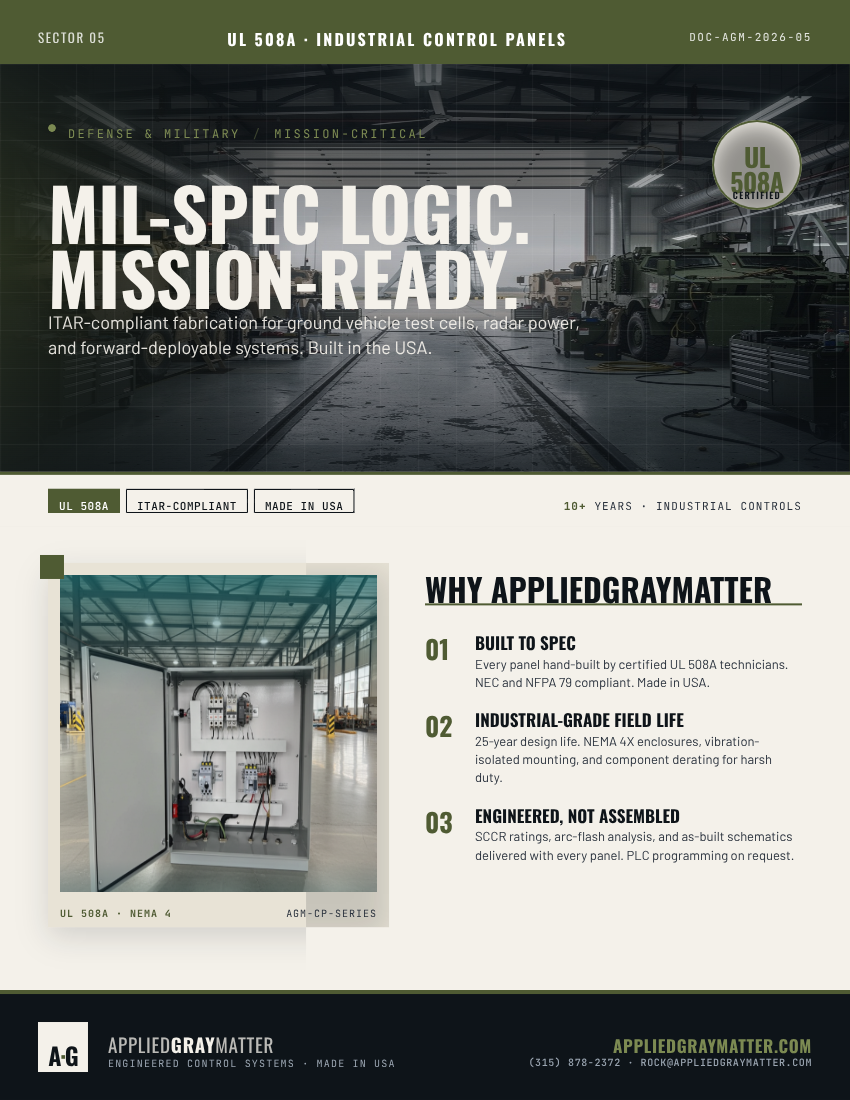
For defense and mission-critical programs, control panel selection is not just a technical decision — it is a risk decision
Aerospace and defense
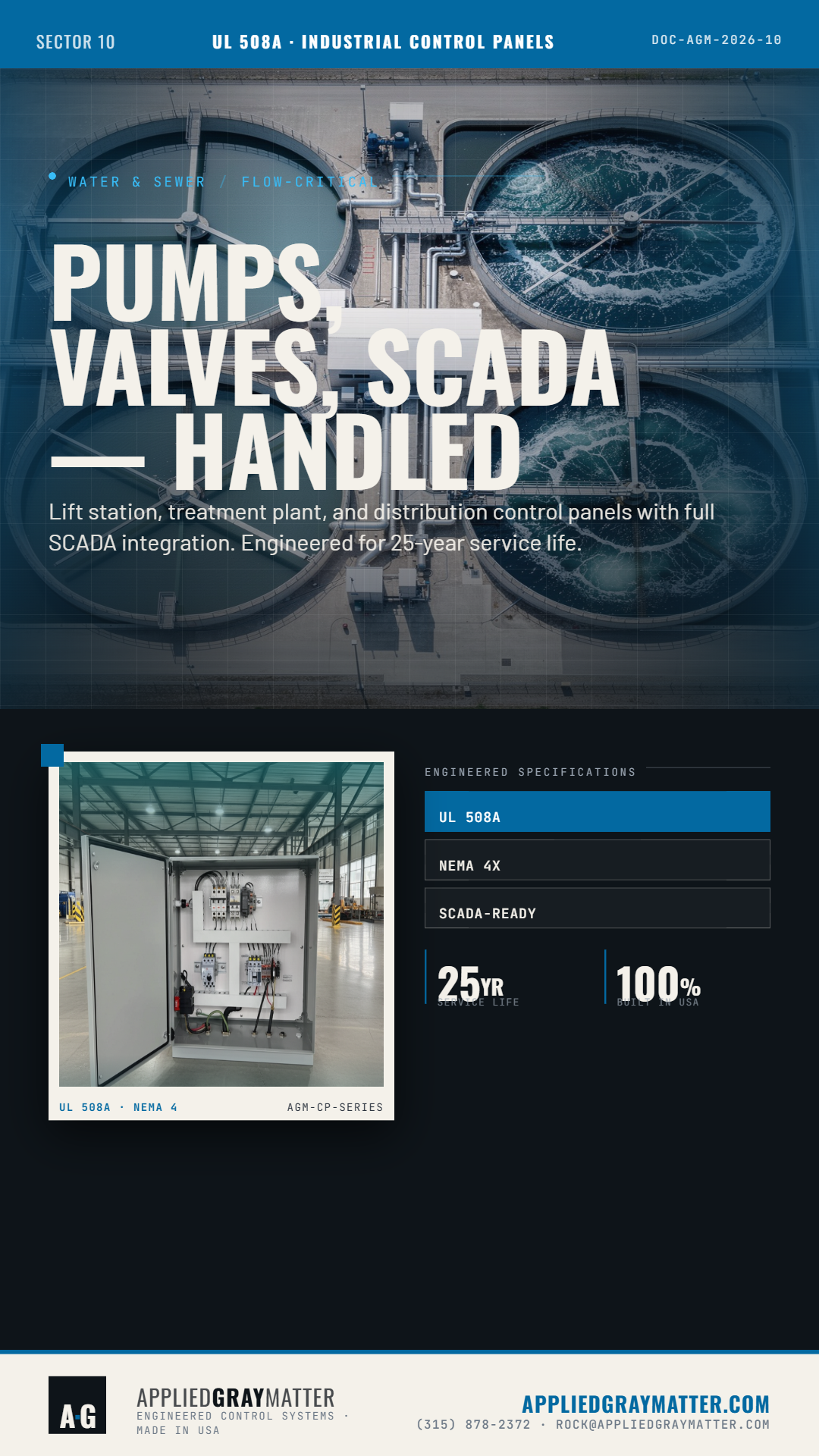
We build test-cell instrumentation panels, engine-run stand controls, and ground-support equipment for aerospace primes and their tier-one suppliers. This work runs under UL 508A on the electrical side, IPC J-STD-001 on the workmanship side, MIL-STD-810 for environmental qualification, and ITAR data controls for anything touching defense-articles export lists. My IPC J-STD-001 certification is not decorative — it is the workmanship standard that governs solder joints, crimp terminations, harness routing, and conformal coating on military and aerospace assemblies. When we build a defense panel we build it to that standard, and our inspection records go with the panel.
Automotive and EV manufacturing
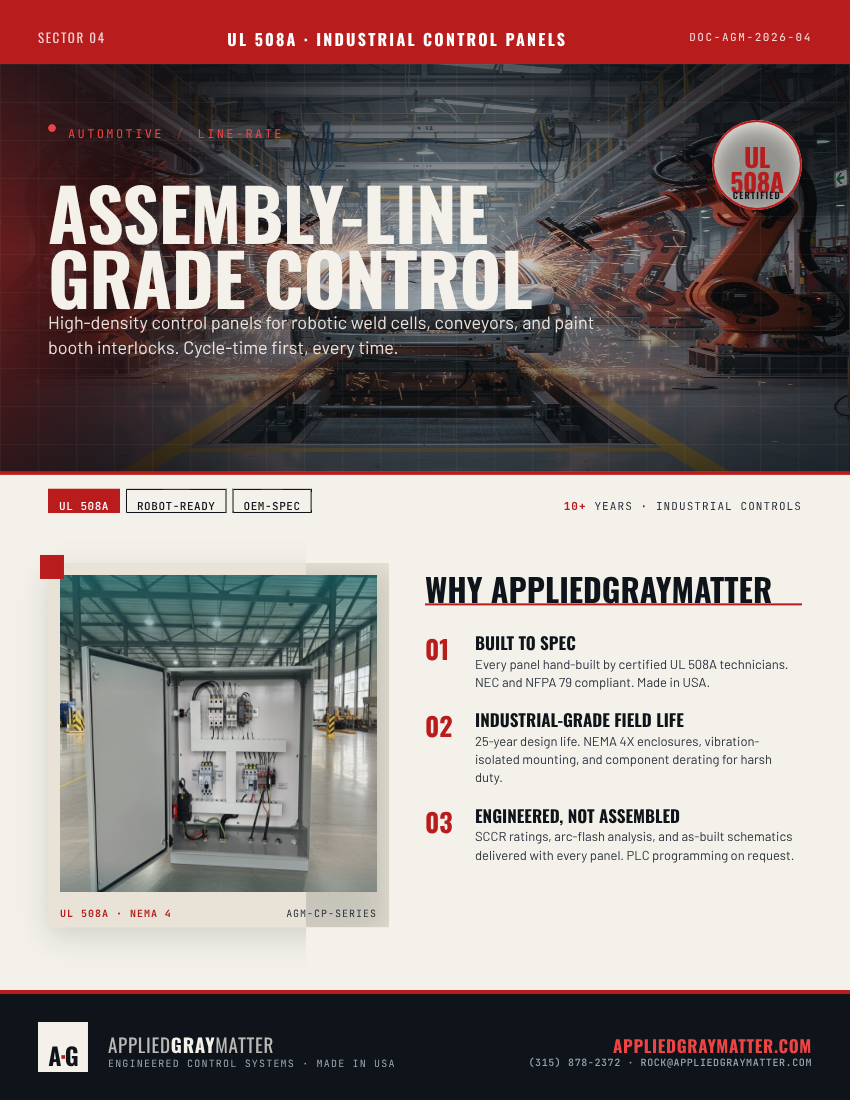
Body-shop weld cells, powertrain assembly lines, EV battery module and pack assembly lines, cell-formation systems, and end-of-line test benches. This is Rockwell Integrated Architecture and Siemens TIA Portal country, and we’re fluent in both. The EV segment specifically has driven us into some of the highest-power panel work we do — 480 VAC three-phase feeds at hundreds of amps, DC bus voltages up to 1500 V for cell-formation, and safety-integrity requirements up to SIL 3 for high-voltage isolation systems. The tolerances are tight, the schedules are unforgiving, and the safety implications of a wrong panel are severe. This is exactly the environment our engineering discipline was built for.
Automated parking
This is one of the more unusual verticals in our portfolio and it exists because our Managing Director, Kevin McDaniel, built and sold companies specifically in automated parking. An automated parking structure has pallet shuttles, vertical elevators, rotary carousels, occupancy sensors, license-plate recognition cameras, payment kiosks, and life-safety systems that all have to interlock reliably under conditions that include a car being physically present in a moving mechanism. The control panels for these systems are unlike anything else we build. They exist at the intersection of industrial automation, building automation, and life safety, and there are only a handful of shops in the country that have built them. We have.
Energy production and energy management
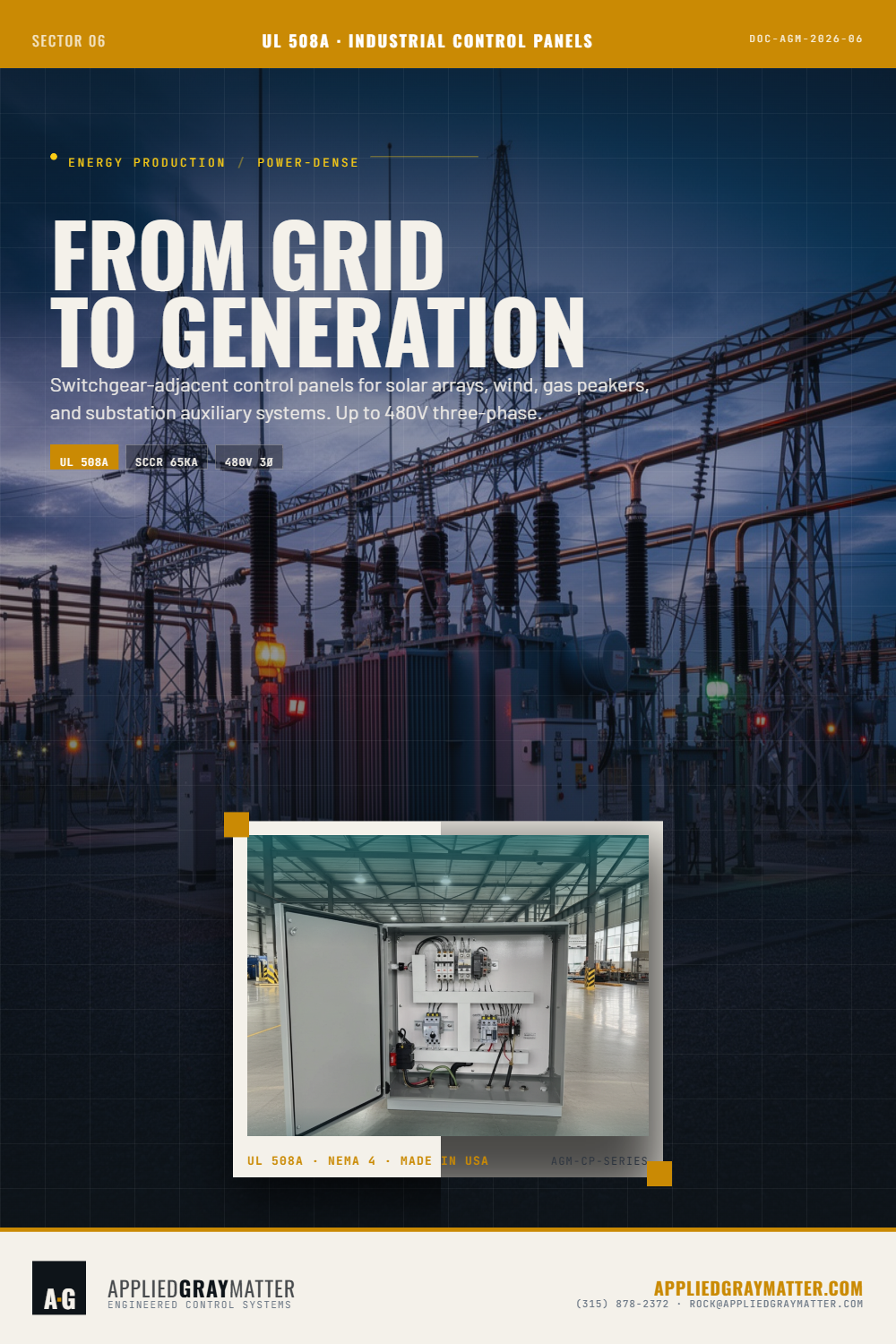
Utility-scale solar combiner and recombiner controls, wind-turbine yaw and pitch controllers, microgrid interconnection switchgear controls, battery energy-storage system controllers, and utility-grade metering panels. This is the domain where our own product, the AGM Battery Emergency Backup System, or BEBS, lives — a modular, UL-certified, low-emission battery backup platform that we design in scales from a small commercial retail location up to megawatt-class critical-load resilience.
Environmental monitoring
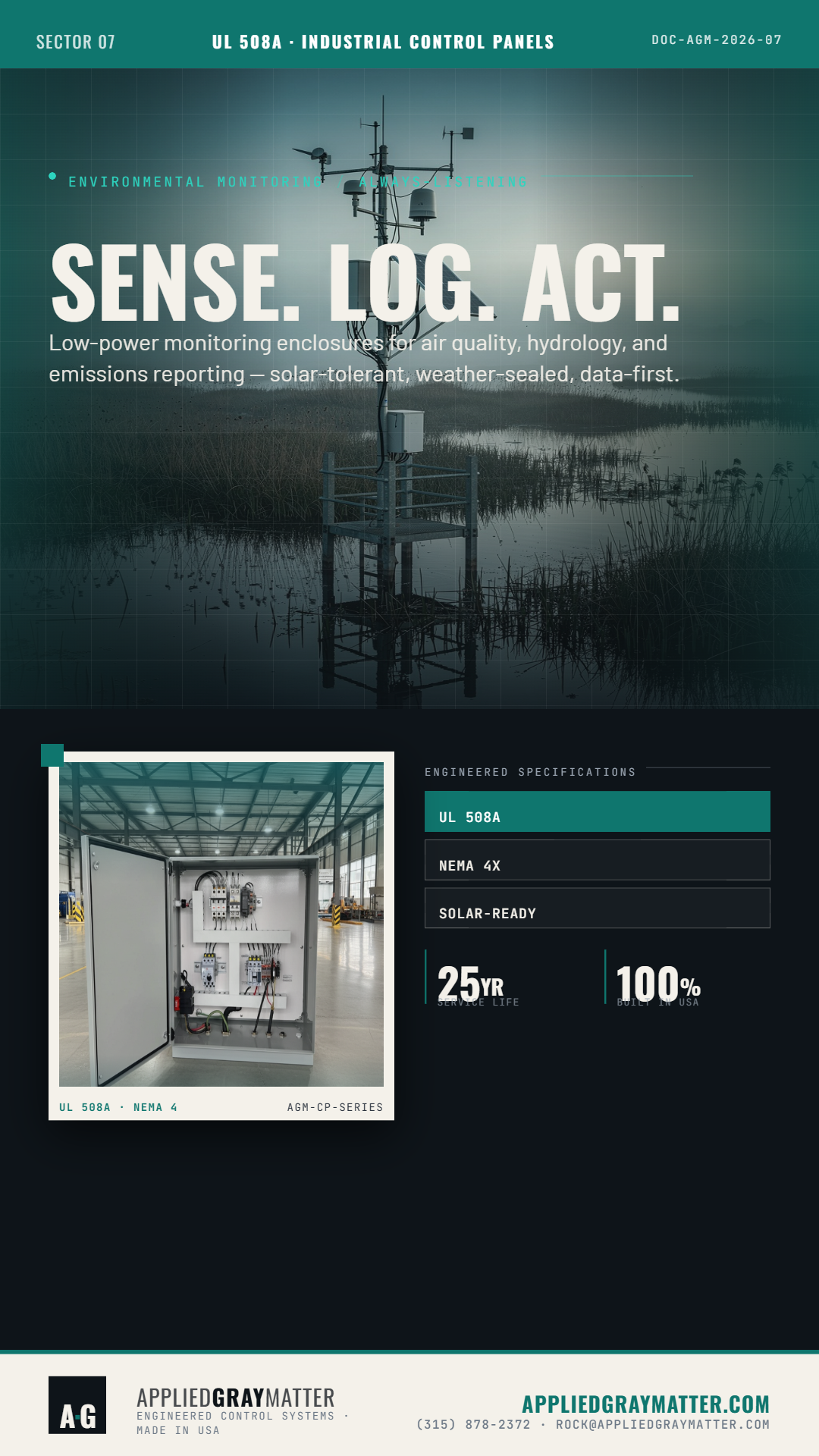
Continuous emissions monitoring systems (CEMS), stack gas analyzers, wastewater flow and quality monitoring, air-quality reference-method stations. These panels have unusual documentation and traceability requirements because they generate data that is submitted to state and federal environmental regulators as compliance evidence. The data-logging accuracy, the calibration audit trail, and the tamper detection are all first-order design considerations.
Oil and gas
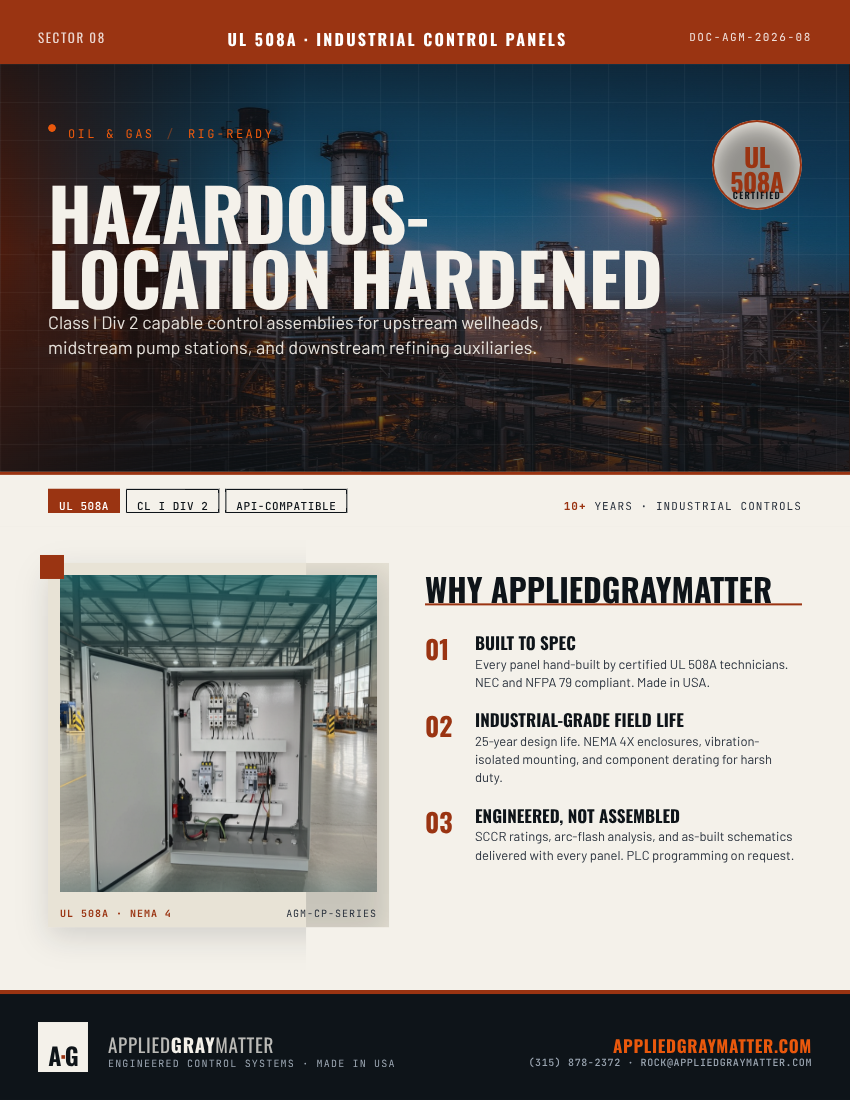
Emergency shutdown (ESD) logic-solver panels for well-pad and midstream applications, custody-transfer flow-computer panels, cathodic-protection rectifier controls, and pig-launcher instrumentation. Class I Division 1 and Division 2 hazardous-location design, purge-and-pressurization (Y-purge and Z-purge) systems, and IECEx documentation for export to the Middle East, West Africa, and offshore platforms. The stakes are life-safety stakes and the AHJs are unforgiving. We build to that standard because we have to.
Medical device manufacturing and pharmaceuticals
FDA 21 CFR Part 11-compliant electronic records and electronic signatures, GAMP 5 validation packaging, GxP audit trails, and cleanroom-rated stainless-steel enclosures with sanitary cable entries. Vince Cianchetta, our Director of Operations, has years of medical-device systems-integration experience and has led validation packaging on some of the most rigorous pharmaceutical clients in the country. When your regulatory-affairs team says “we cannot ship product until this panel is validated,” we understand what those words mean.
Food and beverage and protein processing
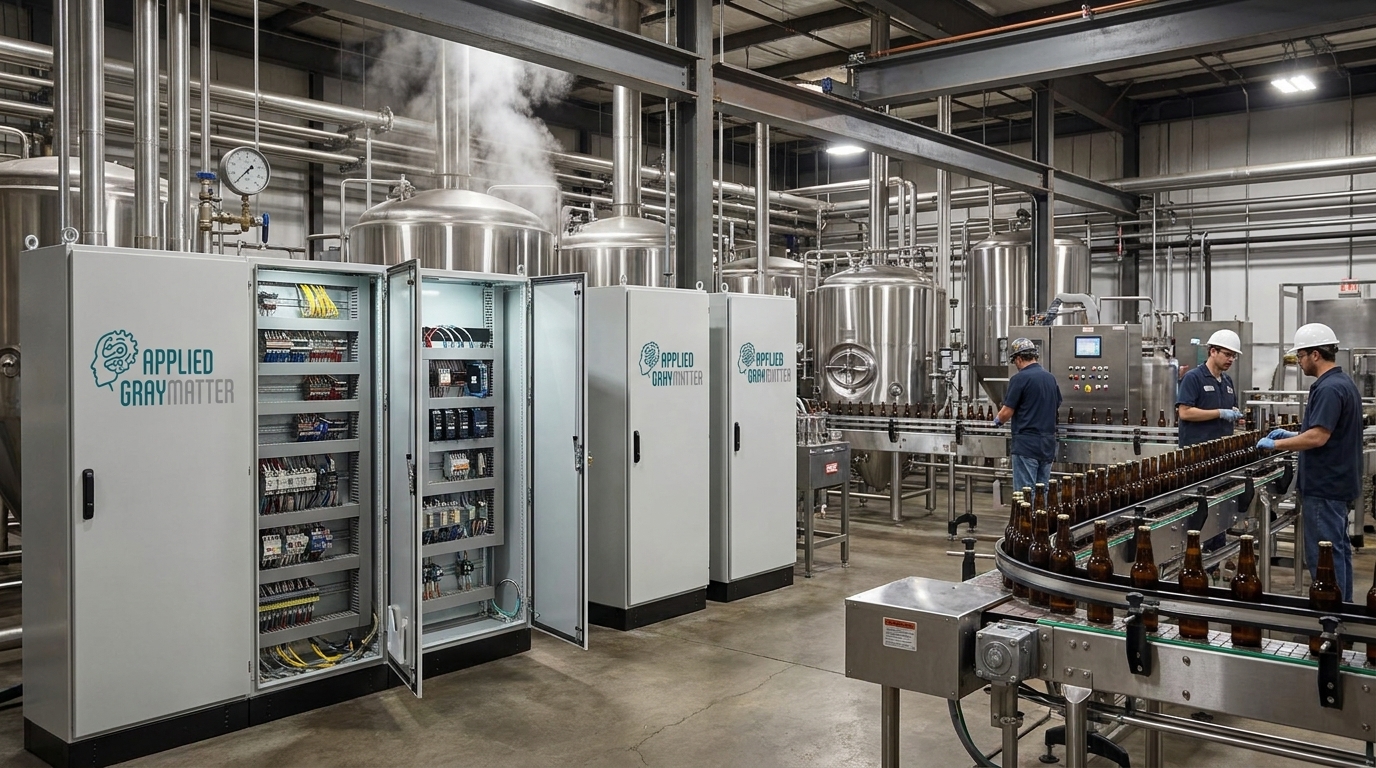
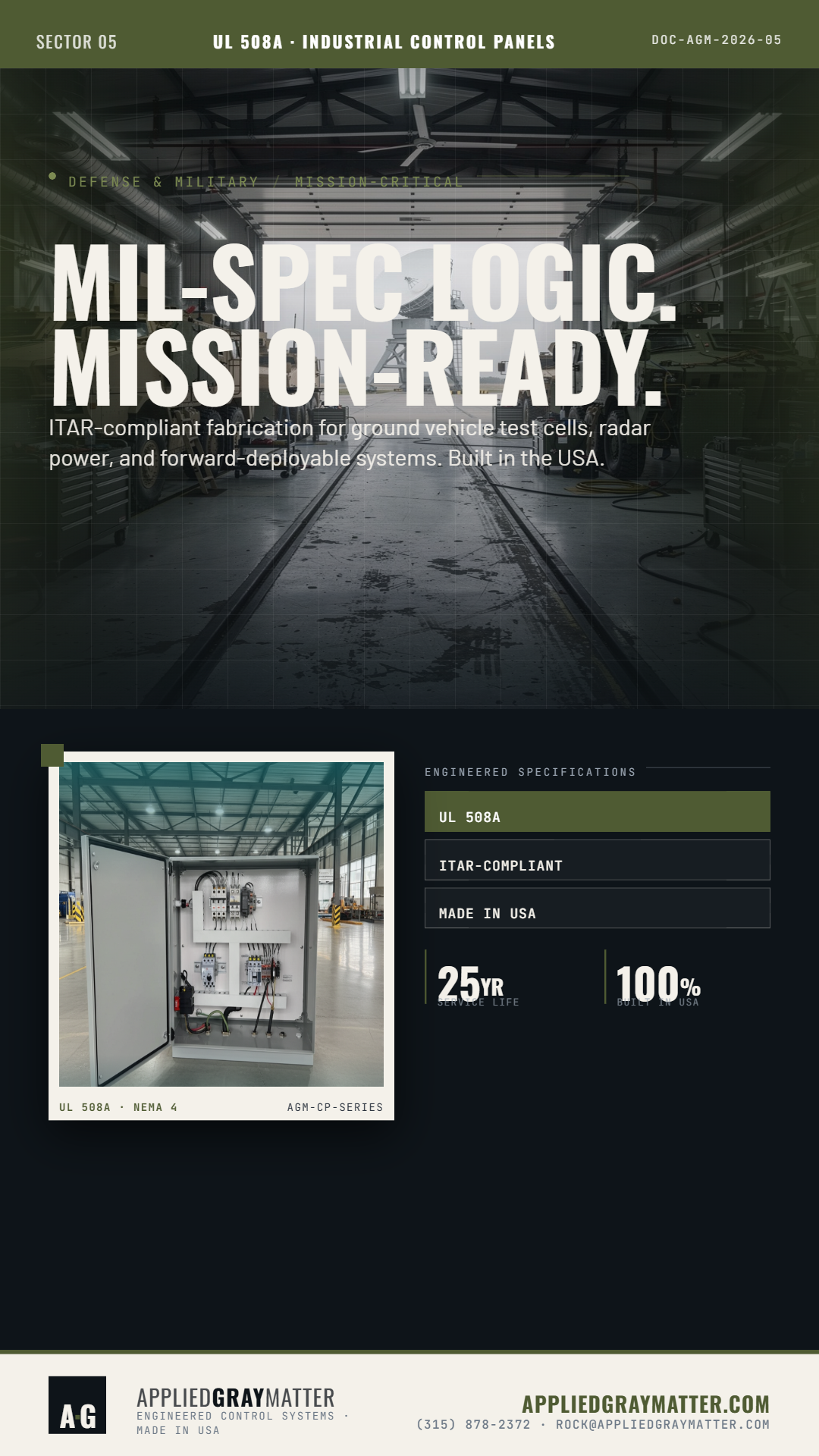
NEMA 4X stainless-steel washdown enclosures, sloped tops to prevent water accumulation, silicone-free construction where required, sanitary cable glands, and IFS/FSIS/USDA-compliant documentation. Vince’s roots are in this vertical — he built control systems on protein-processing lines through the 1990s and 2000s and knows every regulatory nuance from ammonia refrigeration interlocks to metal-detector rejection systems to CIP sequence validation.
Agriculture
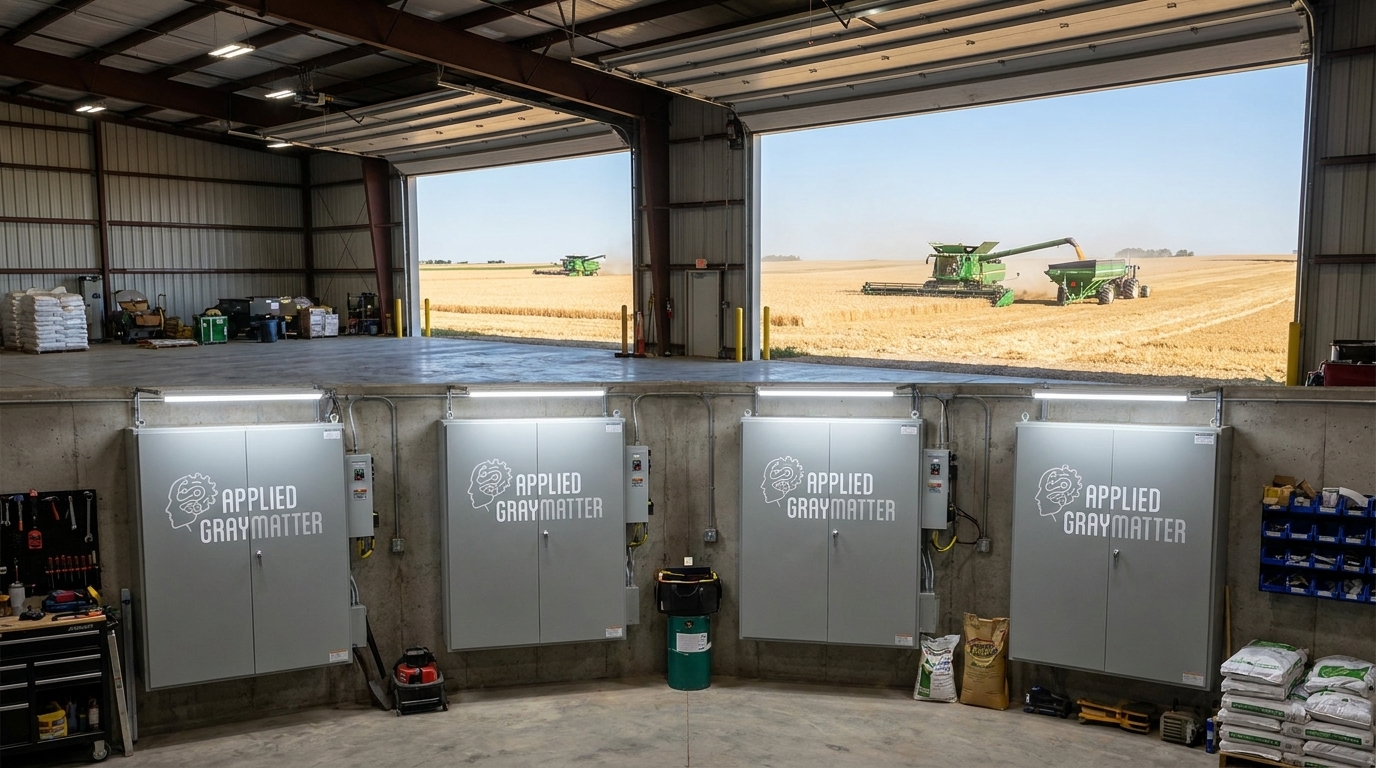
Precision-irrigation pump controls, center-pivot variable-rate systems, grain-handling and drying automation, and controlled-environment agriculture (CEA) climate panels for indoor vertical farms and greenhouse operations. This vertical has grown rapidly for us as CEA capital investment has accelerated across the U.S. and Canada.
Commercial and institutional facilities
Chiller-plant sequencing panels, boiler and hot-water plant controls, hospital normal/essential/critical branch panels under NFPA 99, university central-plant controls, and BAS front-end integration. Building automation is a distinct sub-discipline of controls with its own standards (ASHRAE, BACnet) and its own regulatory environment, and we work fluently across the industrial-to-commercial boundary.
The industry that changes everything: hyperscale and colocation data centers
I’ve saved data centers for its own section because in 2026 this vertical alone is reshaping the entire industrial-controls industry. The AI training buildout has pushed U.S. hyperscale construction into a supercycle that shows no sign of slowing. Sites that were permitted for 100 MW three years ago are now permitting for 500 MW campuses. Liquid-cooled GPU racks that draw 130 kW per rack are moving from experimental to standard. Colocation providers are retrofitting brownfield facilities as fast as their utility interconnections can be re-studied. Every one of these sites needs control panels — hundreds of them per campus — and the panels have to hit engineering standards that most shops have never even attempted.
Here is what a data-center-grade control panel actually requires, and what most shops get wrong.
Six-nines uptime is not a marketing claim. It is a design constraint that ripples through every decision. A facility targeting 99.9999% availability tolerates 31.5 seconds of unscheduled downtime per year. That budget is spent quickly. It means every panel that touches critical load is minimum 2N redundant at the power layer — two entirely independent 24 VDC control supplies, each backed by its own battery, each feeding through diode ORing so that a fault in one supply cannot propagate to the other. It means N+1 redundancy at the control layer — hot-swappable I/O modules on ControlLogix or CompactLogix, dual-Ethernet ring topologies using DLR (Device-Level Ring) or PRP/HSR (Parallel Redundancy Protocol / High-availability Seamless Redundancy) so that a single fiber cut does not take down a domain. It means online-programmable PLCs so firmware updates never require a shutdown. Most panel shops have never built to this standard because most of their customers have never demanded it. Data centers demand it as the entry condition.
Generator paralleling and automatic transfer switching is its own engineering discipline. A modern hyperscale campus routinely operates 20 megawatts or more of standby diesel or dual-fuel natural-gas generation, paralleled through medium-voltage switchgear, synchronized via Woodward easYgen, Basler DGC-2020, or ComAp InteliGen controllers, with sub-cycle synchronization windows and load-share bias adjustments that must ride through utility sags and voltage-tolerance events without dropping the critical load. AGM builds the paralleling switchgear control panels, the ATS controllers, the utility phase-monitoring panels, and — this is the part most shops cannot do — the integration between the generator paralleling controls and the BMS/DCIM front end. Getting a generator paralleling scheme to close its tie breaker reliably on the third night of commissioning is not a matter of buying a Woodward. It is a matter of understanding governor bias, voltage droop, dead-bus arbitration, cross-current compensation, and the timing relationships between the sync-check relay, the breaker close coil, and the load-shed sequencer. This is the work I get called about at 3 a.m. Not because Woodward controllers are bad. Because someone speced them without understanding what they were about to build.
Cooling-plant control is where the mission-critical margin lives. Chiller sequencing, cooling-tower fan VFD control, primary/secondary/tertiary pumping-loop coordination, CRAH/CRAC coordination with hot-aisle and cold-aisle containment, and now — increasingly — liquid-cooled rack manifold control panels for NVIDIA GB200 NVL72 and AMD MI300X-class GPU installations. Liquid cooling is the fastest-growing subvertical inside data-center controls and it is where the newest engineering problems live: coolant distribution units (CDUs), rack manifold pressure and flow control, leak detection, redundant pump control with automatic failover, coolant chemistry monitoring, and interlock with the site’s chilled-water plant. AGM has designed panels for all of it, and we’ve done the systems engineering work to understand what happens when a leak sensor trips on rack 47 at 2:00 a.m. — how the controls isolate the leak, shed the load, notify DCIM, and preserve every other rack on the manifold without dropping a training job.
BMS and DCIM integration is where every panel touches the operator. Modern data-center panels export to BACnet/IP, Modbus TCP, and increasingly MQTT Sparkplug B for DCIM platforms including Schneider EcoStruxure IT, ABB Ability Data Center Automation, Vertiv Trellis, Nlyte, and Sunbird dcTrack. AGM ships every data-center panel pre-configured with the tag structure your DCIM expects, tested against a simulator, and documented in a tag database that your DCIM integrator can ingest directly. We do not deliver panels that require the DCIM team to invent tags from scratch. We deliver panels that plug into the front end and start reporting immediately.
Sub-metering and sustainability instrumentation is now a requirement, not a nice-to-have. Every hyperscale tenant wants proof of PUE under 1.25. Every ESG-conscious operator is measuring WUE and CUE alongside PUE. Every jurisdiction with a data-center energy disclosure ordinance — increasingly, every jurisdiction — requires branch-circuit-level power monitoring feeding into an ISO 50001 energy management system. AGM’s data-center panels include the sub-metering circuits, the branch-circuit power monitors, and the ISO 50001-compatible data structures built in. If you’re deploying an AI campus in 2026, you’re not going to want to retrofit metering later. Get it right in the panel.
Battery energy storage integration is where AGM’s BEBS product becomes strategic. Modular, UL-certified, low-emission, sized from small commercial UPS replacement to megawatt-class critical-load resilience, and — crucially — designed to be code-compliant against NFPA 855 for stationary energy storage systems. A BEBS installation at a data center can serve as an alternative to lead-acid UPS strings, as a peak-shaving asset that pays for itself against utility demand charges, as a black-start energy reserve for generator paralleling schemes, or as a resilience backstop during the increasingly common utility-driven load-shed events that hyperscale sites see in constrained grids. We build both the BEBS itself and the interconnection controls that make it play nicely with the rest of the facility.
I want to be direct about something. The data-center vertical has attracted an enormous number of new entrants in the last two years — panel shops that had never built a paralleling switchgear panel now claim to be “data center specialists.” Some of them will do fine work. Some of them will not, and the failures are going to become public over the next 18 months as commissioning delays compound and hyperscale operators start naming names in their construction reports. Applied Gray Matter is not a new entrant. We came into data centers because our discipline in oil and gas, aerospace, and medical-device work translated directly. Our engineers understand mission-critical because they’ve built mission-critical for two decades in industries where a control-panel failure meant a hospital going dark, a well pad flaring, or a defense program slipping. We didn’t retool for data centers. We were already built for them.
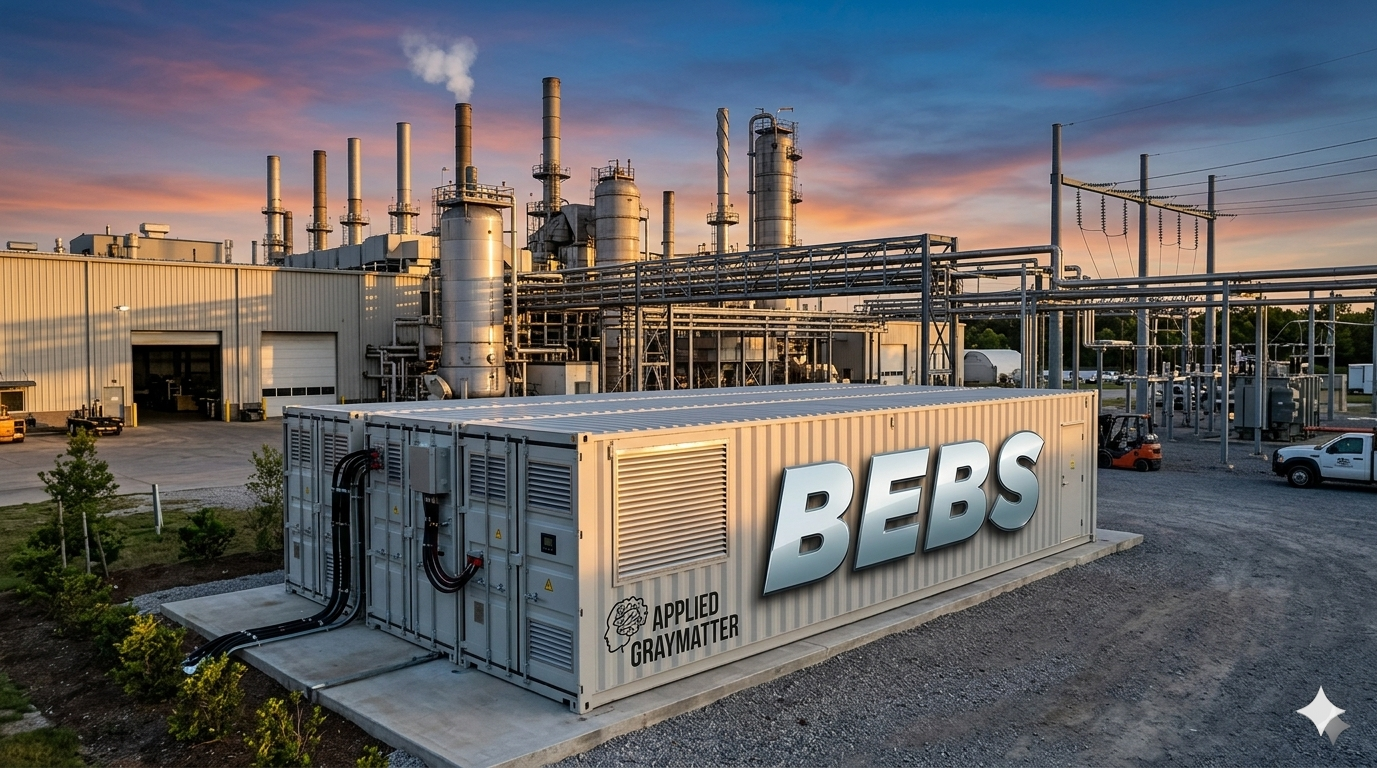
Industrial Battery Backup and Industrial Energy Storage Systems (ESS). Our solutions are designed to help industrial facilities maintain uptime, protect critical operations, and reduce the risk of costly interruptions caused by power disruptions.
Don’t let outages, voltage fluctuations, or unexpected grid failures interrupt productivity. Applied Gray Matter’s BEBS and ESS solutions provide clean, reliable, and scalable backup power for industrial equipment, automated systems, commercial facilities, and mission-critical operations that can’t afford downtime.
These systems can also support broader energy goals, including peak shaving, load shifting, renewable integration, and long-duration backup power for facilities that need more than a traditional UPS can provide. In industrial environments, that means better resilience, improved energy control, and a smarter path to business continuity.
Call us today at (315) 878-2372 for a free consultation.
The compliance and certification stack, in one place
For customers who are exporting equipment, serving multiple jurisdictions, or working across regulated verticals, the certification stack matters. Here is what AGM delivers and why each certification matters.
UL 508A is the North American standard for industrial control panels. Required for every industrial panel installed in the U.S. and Canada under NEC Article 409 and its Canadian equivalent. AGM is a UL 508A listed shop with multiple MTRs on staff.
UL 698A covers industrial control panels for use in hazardous locations. Required when the panel serves any Class I, Class II, or Class III environment. AGM delivers UL 698A-labeled panels for oil and gas, ethanol, grain-handling, and pharmaceutical solvent-recovery applications.
CE marking under LVD 2014/35/EU and EMC 2014/30/EU is required for any equipment shipped into the European Economic Area. AGM prepares the Technical File, performs the risk assessment under EN 60204-1, verifies EMC compliance under EN 61000-6-2 and EN 61000-6-4, and issues the Declaration of Conformity.
NFPA 79 governs industrial machinery in the U.S. and is the American cousin of EN 60204-1. AGM builds to NFPA 79 for all machine-tool, packaging-machine, and OEM equipment control panels.
NEC Article 409 is the electrical code section governing installed industrial control panels in the U.S. AGM’s panels are compliant at delivery.
NFPA 70E governs electrical safe work practices, including the arc-flash label content and the incident-energy calculation. AGM performs the IEEE 1584 calculation and delivers the label.
IPC J-STD-001 governs the workmanship of soldered electrical and electronic assemblies. Required for defense and aerospace work. AGM engineers hold current certifications.
IEC 62443-4-2 is the cybersecurity standard for OT components. AGM builds to Security Level 2 as a baseline and Security Level 3 on customer request.
NFPA 855 governs stationary battery energy storage systems. AGM’s BEBS product is designed to NFPA 855 and integrates with the site’s fire-protection and gas-detection systems.
IECEx and ATEX cover hazardous-location equipment for export to Europe, the Middle East, and offshore. AGM’s oil-and-gas panels are IECEx-documented on request.
If your project touches any of these standards, we’ve built to it. If it touches all of them, we’ve built to that too.
What partnering with AGM actually looks like
I want to close on what the partnership feels like, day to day, because too much sales copy in this industry is about specifications and not enough is about what it’s like to work with the shop that’s building the most important electrical enclosure in your facility.
We start with a scoping conversation. Not a proposal. A conversation. One of our senior engineers — often me, often our Director of Operations, sometimes Kevin himself on strategic accounts — gets on a call with your team and asks the questions your consulting engineer probably didn’t ask. What is the available fault current? What is the ambient temperature at the worst-case installed location? What is the altitude? What is the corrosion class? What is the seismic zone? What is the network security posture? What is the redundancy budget? What is the schedule? What is the CapEx tolerance versus the lifecycle cost preference? If we get the answers, we deliver a proposal within a week that reflects a real understanding of the project. If we don’t get the answers, we tell you what we need and we help you find them.
Once the project is booked, you get a named lead engineer. That engineer stays with the project through commissioning. They are not a fungible resource. They are the person who will answer the phone when your commissioning team has a question at 11 p.m. on a Sunday. AGM is small enough that this is possible and disciplined enough that this is standard.
You get a Factory Acceptance Test that means something. FAT at AGM is not a five-minute walkaround. It is a full functional test of every I/O point, every interlock, every alarm, every network path, every redundancy transition, and every safety function, witnessed by your team, documented with signatures and photographs, and delivered as a bound package that your validation or commissioning agent can attach directly to the site record. On safety-instrumented systems we run a full SIL verification test. On paralleling switchgear we run a black-start sequence into a load bank. On liquid-cooled rack panels we run a coolant leak sequence into a simulator. If a panel doesn’t pass at AGM’s shop, it won’t pass in your facility. Better to fail here.
You get delivery on your schedule. Our fully-automated wire-processing lines let us hit lead times that most custom shops cannot match — small-run and prototype work in four to six weeks, production runs of 20 to 200 panels in eight to twelve weeks depending on component lead times. We track component supply chain constraints continuously and we tell you the moment a component shifts. We do not surprise our customers with delays.
You get commissioning support. Your project engineer is on site or on a phone bridge for the duration of your commissioning window. If there is a problem, they will not tell you to file a warranty claim. They will get it fixed. If the problem is our shop’s issue, we own it and we fix it at our expense. If the problem is a specification gap on the customer side, we tell you exactly what we see and we work with you on the resolution. Nobody at AGM plays warranty games.
You get lifecycle support. Panels we build in 2026 will be running in 2046. When your integrator calls us in 2035 asking for the drawings, we still have them. When a component reaches end of life and needs a replacement, we help you plan the migration. When a new certification requirement lands — and in cybersecurity, one is coming — we help you understand what it means for your installed base.
That is what partnership means in this industry. It is not a purchase order. It is a twenty-year relationship, and Applied Gray Matter is built to be that partner.
How to get a real quote in 48 hours
If you’re ready to move forward — or even just to compare — the fastest way to get an accurate, defensible quote is to send us six pieces of information. First: a single-line diagram or a written description of the electrical service. Second: the available fault current and voltage at the point of connection, so we can size the SCCR correctly. Third: the enclosure environment, including indoor or outdoor placement, NEMA rating, ambient temperature range, corrosion class, and any seismic requirements. Fourth: the I/O count and the preferred PLC platform (Rockwell, Siemens, Beckhoff, Mitsubishi, Omron, or other). Fifth: the communication requirements — BACnet/IP, Modbus TCP, EtherNet/IP, PROFINET, OPC UA, or MQTT. Sixth: the certification markets — UL only, UL plus CE, plus any client-specific stamps such as FM Global, CSA, IECEx, or ATEX.
If you have a rough panel schedule from your consulting engineer, send that too. If you have a P&ID or a functional description, send it. The more we know at the start, the tighter the quote, and the fewer surprises in commissioning.
Closing
The control panel is the last line item on the P&ID, the last package to be released for construction, and — when it’s built by a commodity shop — the first system to fail in commissioning. That is not a coincidence. It is a consequence of how the industry has treated the panel for the last thirty years, and it is a consequence that mission-critical customers can no longer afford. A two-week commissioning delay on a $400 million data-center hall is roughly $8 million of lost lease revenue. A day of downtime on a $200 million EV battery gigafactory line is roughly $600,000 of missed production. A failed batch on a $50 million pharmaceutical validation campaign is roughly six months of regulatory delay. The panel is on the critical path of every one of those numbers.
The panel is not a commodity. It is the engineered nervous system of your facility, and it deserves to be treated that way.
At Applied Gray Matter we build panels the way an aerospace prime builds flight hardware. With a documented modified-method SCCR. With a stamped IEEE 1584 arc-flash label. With a segregated, blue-jacketed IS design where it’s required. With cooling sized to the actual heat load. With an IEC 62443 cybersecurity posture. With a maintainable, editable, native-format drawing package. With an engineering team that has picked up the phone at 3 a.m. more times than we can count, and who will pick up when it’s your commissioning night.
If you are evaluating panel shops for a data-center buildout, a manufacturing line expansion, a medical-device production floor, a fleet of EV chargers, an oil and gas project, a defense program, a food and beverage line, an automated parking structure, an agricultural operation, an environmental monitoring installation, a commercial building automation project, or anything else that touches the industries we serve — let’s talk. The first conversation costs you nothing. The wrong panel shop, on the other hand, will cost you everything.
📞 (315) 878-2372 🌐 https://appliedgraymatter.com ✉️ Request a scoping call and a UL 508A MTR-certified engineer will be assigned to your project the same day.
Applied Gray Matter is a UL 508A and UL 698A certified control-panel manufacturer headquartered in Anaheim, California, serving OEMs, EPCs, Fortune 500 manufacturers, and hyperscale data-center developers across North America and internationally under CE marking. Our engineering team’s cumulative 60-plus years span aerospace, defense, medical device manufacturing, automotive, oil and gas, food and beverage, pharmaceuticals, energy production and management, automated parking, agriculture, environmental monitoring, commercial and institutional facilities, and mission-critical data-center infrastructure. If it needs a control panel and it can’t afford to fail, we build it.