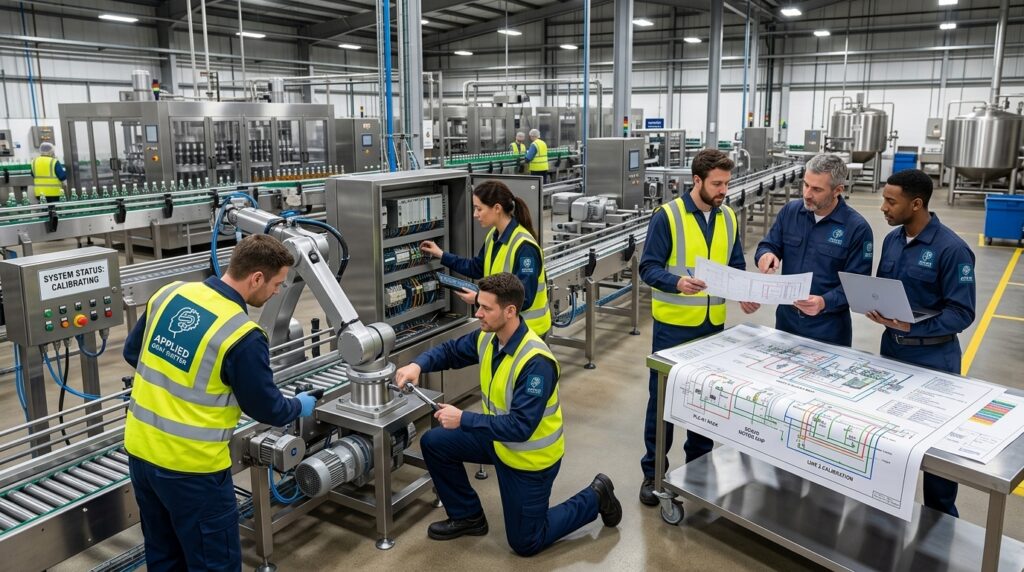
Experienced UL 508A Control Panel Fabrication & Other Emergency Services, Ready When Your Plant Can’t Wait
Experienced UL 508A Control Panel Fabrication, Ready When Your Plant Can’t Wait When a control panel fails, an automated line...

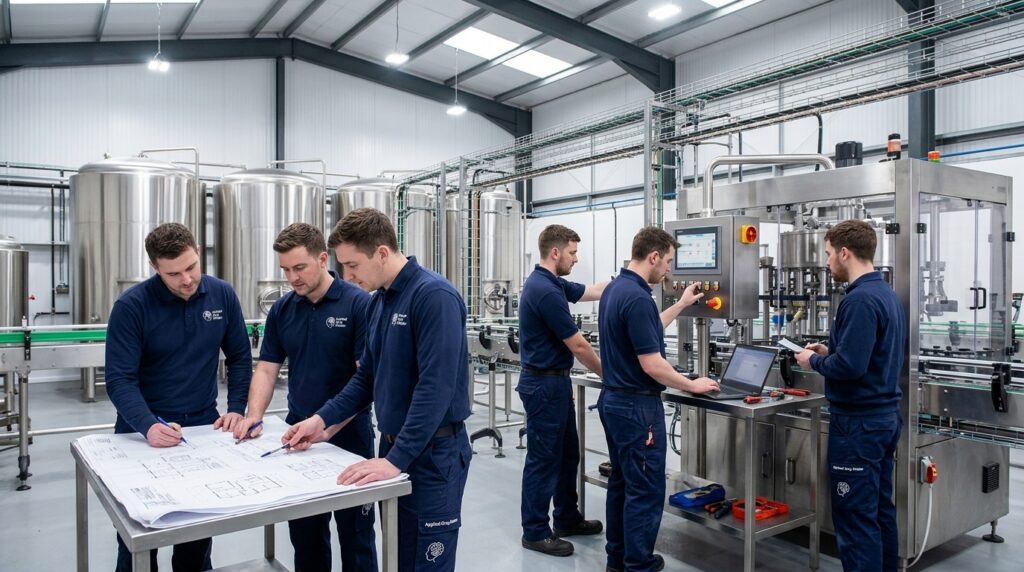
Industrial Machine Downtime Is a Solvable Engineering Problem — Here’s the Playbook We Use to Solve It
Unplanned downtime is not bad luck. It is the accumulated cost of skipped commissioning, undocumented control logic, and field-service work that treats symptoms instead of causes. This is the engineering-first playbook we run at Applied Gray Matter for the operators who cannot afford another silent hour on the floor — from medical device lines to hyperscale data centers.
By the Applied Gray Matter Engineering Team — Rock Grbic, Director of Engineering (UL508A MTR, NFPA 70, IPC J-STD-001); Vince Cianchetta, Director of Operations (30+ years in industrial systems integration across food & protein, oil & gas, medical device, defense, and automotive); Kevin McDaniel, Managing Director. Reviewed September 2026.
1. What downtime actually costs — and why the headline number is understated
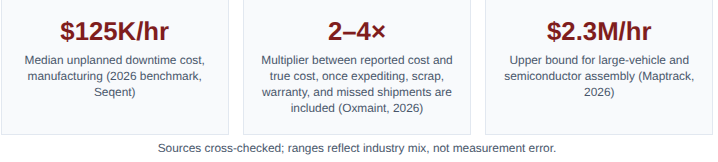
The number every operations director has seen quoted is roughly $260,000 per hour — the Aberdeen Group average across manufacturing sectors, still cited in 2026 by Reliability Magazine, Oxmaint, and the TWI Institute. Newer 2026 benchmarks put the median closer to $125,000/hr, with a range from about $36,000/hr for FMCG to $2.3M/hr for large-vehicle assembly (Seqent, Maptrack).
Industrial Machine Downtime Is a Solvable Engineering Problem — Here’s the Playbook We Use to Solve It
Those headline numbers are still understated in most facilities we audit. They capture lost throughput, but they miss the second-order losses that show up on the P&L two quarters later: expedited freight to hit committed ship dates, warranty exposure from parts run outside validated envelopes, energy penalties from batch restarts, and — the one nobody wants to write down — the engineering hours your best technicians spend rebuilding control logic they didn’t design.
True hourly cost = Lost margin per unit × ideal rate + fully-loaded labor idle + scrap and rework + expedite/freight to recover the shipment + energy and utility penalty + the amortized engineering hours to fix a defect that shouldn’t have shipped. In the plants we survey, items 3–6 average 1.8× to 3.1× item 1.
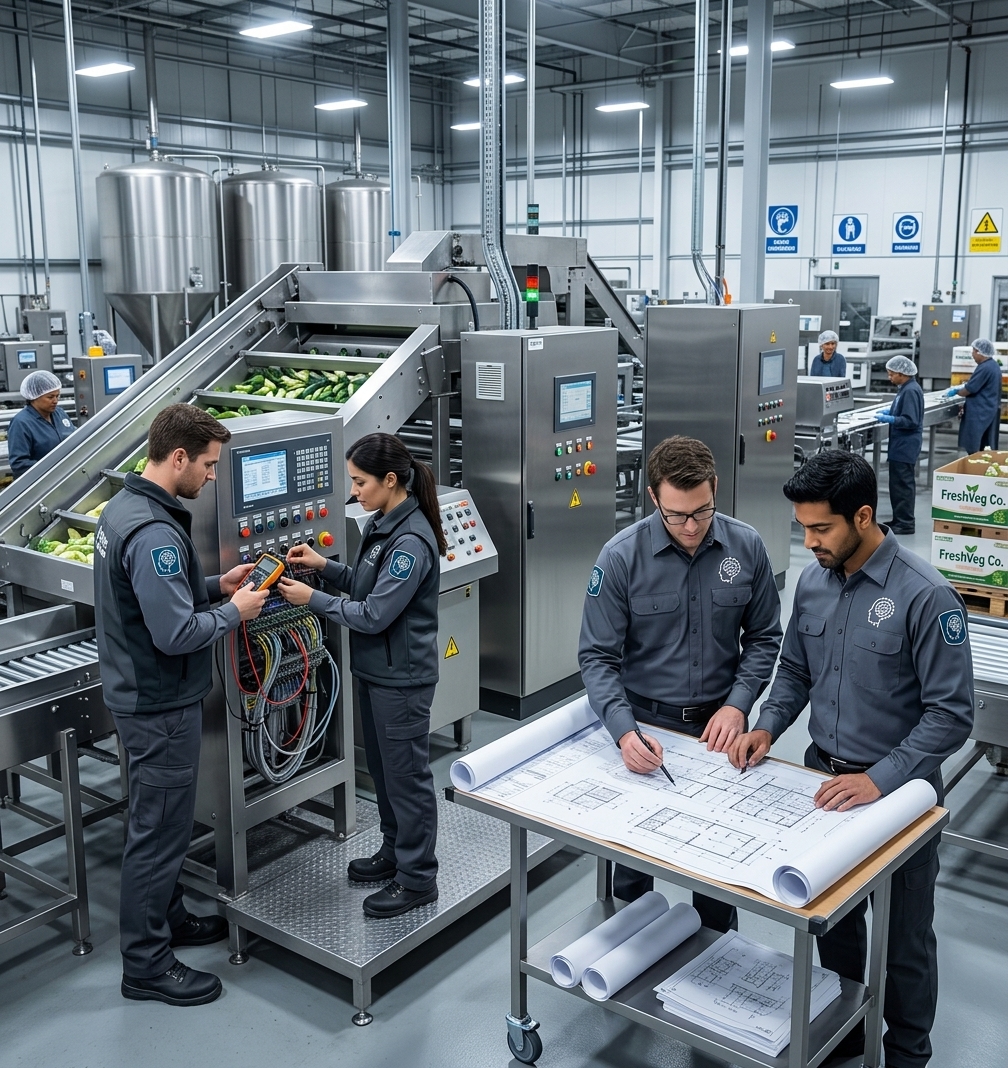
Every unplanned stop we’ve been called in on — and after decades across food & protein, oil & gas, defense, medical device, and automotive, that number is in the thousands — traces back to one of five root categories. Most teams misclassify the category because the first-visible symptom lies.
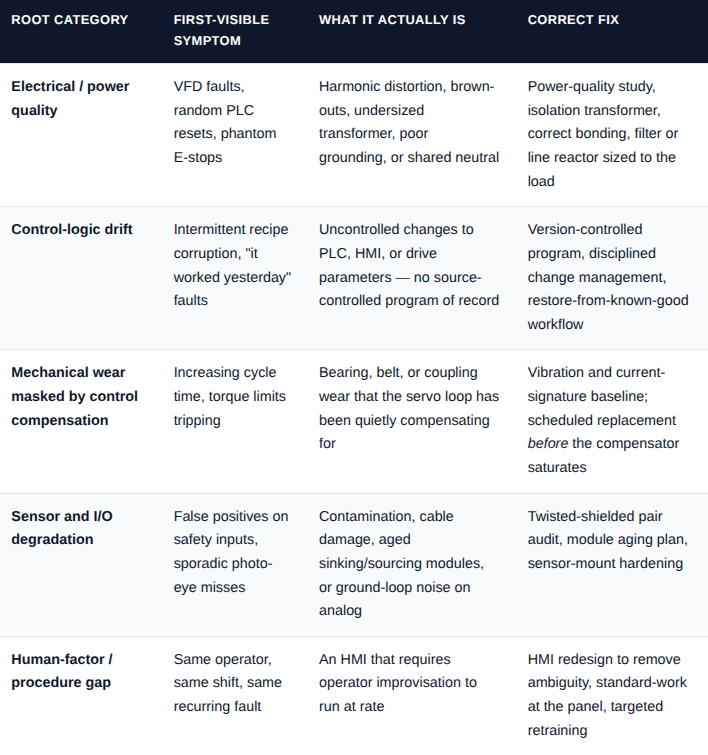
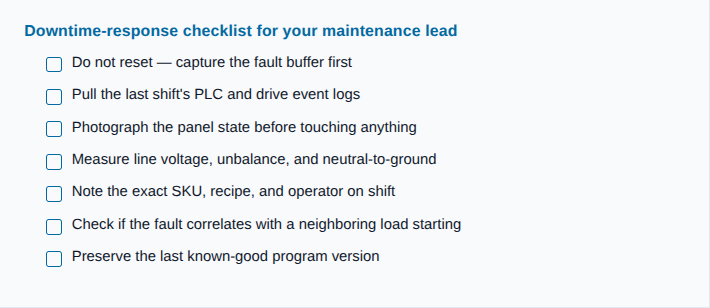
The mistake we see most often: a team replaces a drive three times because the drive keeps faulting, when the actual root cause is a harmonic that only appears when a neighboring 200-HP load starts. The drive isn’t broken; the electrical environment is. This is why troubleshooting is a discipline, not a parts-swap.
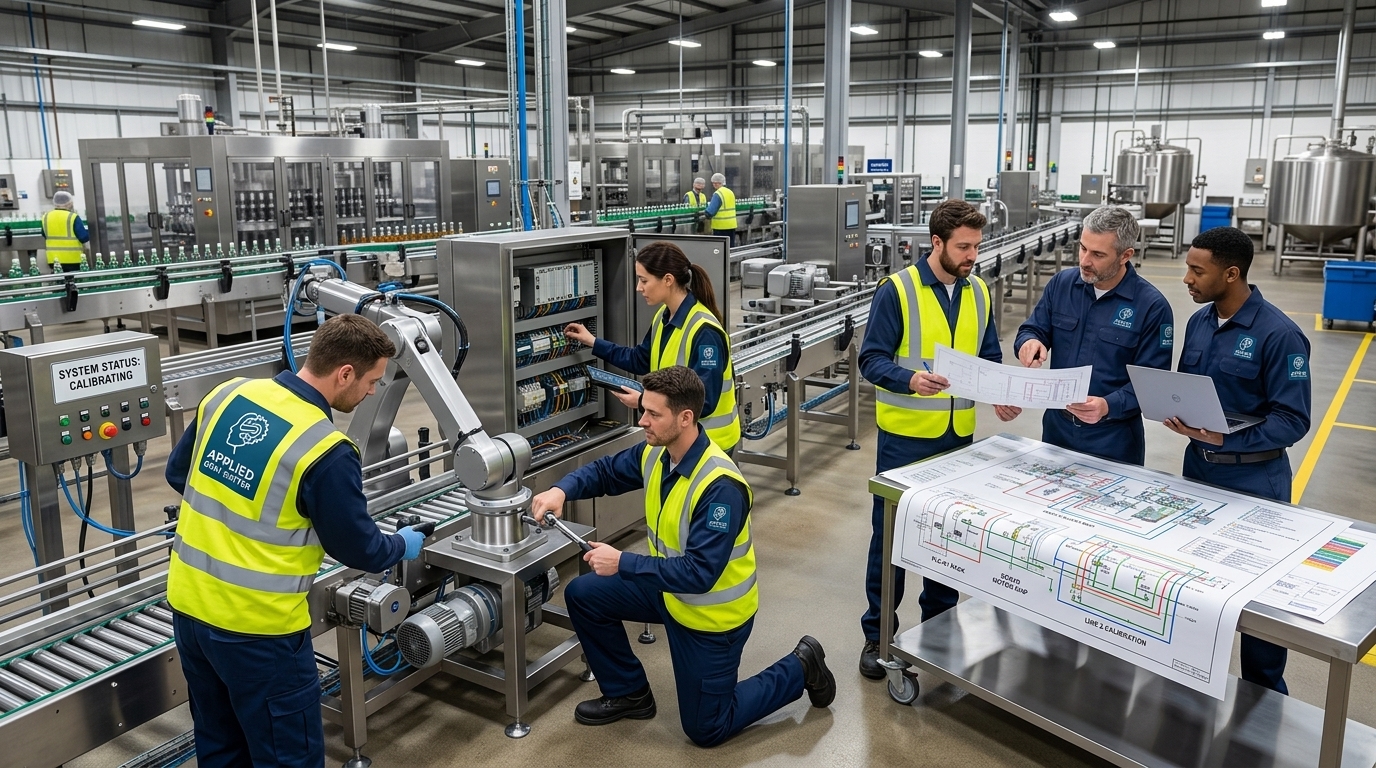
When we deploy a field engineer, they run the same seven-step protocol whether the machine is a robotic weld cell in an automotive plant, a fill-line in a protein facility, or a UPS/PDU in a data-center white space. The order is not negotiable — step three catches the electrical failures that steps five through seven would otherwise chase for a week.
Before anyone resets an alarm, we capture the fault buffer, drive event log, PLC diagnostic status, and HMI alarm history. On a modern Rockwell, Siemens, or Beckhoff system, a hard reset destroys the highest-value clue — the exact fault code at the exact millisecond. If your maintenance team’s first move is a power cycle, you are paying for downtime you cannot learn from.
We pull the last 24 hours of production data — cycle counts, energy draw, temperature trends, changeover events. Almost every intermittent fault becomes obvious the moment you overlay the fault times against a second dataset: shift change, feedstock lot change, HVAC compressor start, or the neighboring line’s ramp-up.
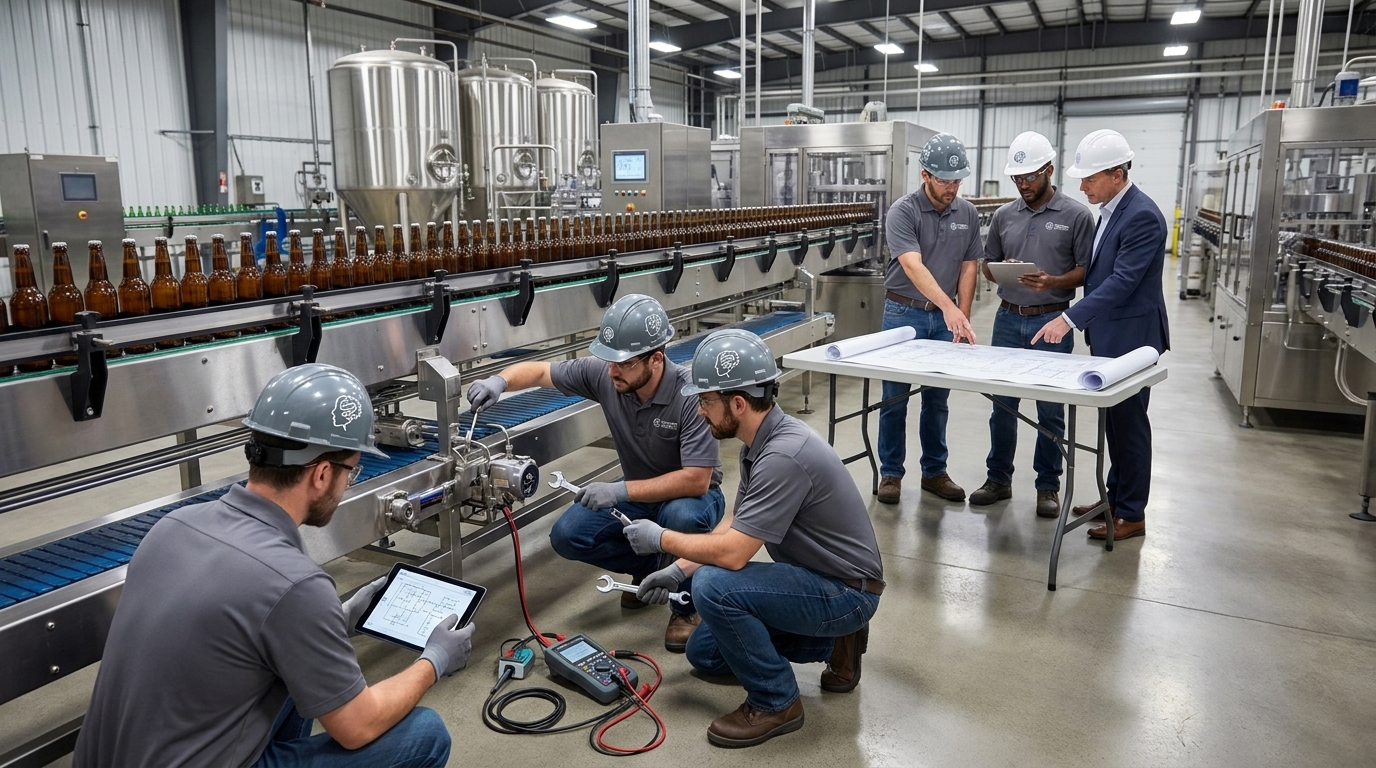
Power quality first, always. We measure THDv, THDi, unbalance, dips, and neutral-to-ground voltage. On more than one job we have closed the ticket in ninety minutes because the “PLC problem” was a floating neutral. Skipping this step is the single most expensive habit in industrial troubleshooting.
We put the machine in a controlled test state and exercise each I/O point independently. This separates a sensor fault from a logic fault from a wiring fault — three problems that look identical from the HMI.
A fault we can reproduce is a fault we can fix. A fault we cannot reproduce is a fault that will come back at 2:00 a.m. on the day of your customer audit. We stay on-site until reproduction is deterministic.
Suppressing an alarm because “it doesn’t matter” is how safety incidents happen. Every alarm exists because an engineer decided it mattered. If it truly doesn’t, the fix is a documented alarm-rationalization change — not a masked bit.

Every change goes into the source-controlled program of record with a change note, a reason, and a signed-off test. If we leave and your team cannot see what changed and why, we haven’t finished the job.
Most automated production lines pass their factory acceptance test. Most also underperform their nameplate rate by month three. The reason is almost always the same: commissioning was scoped as a hand-off, not as a proof of sustained capability.
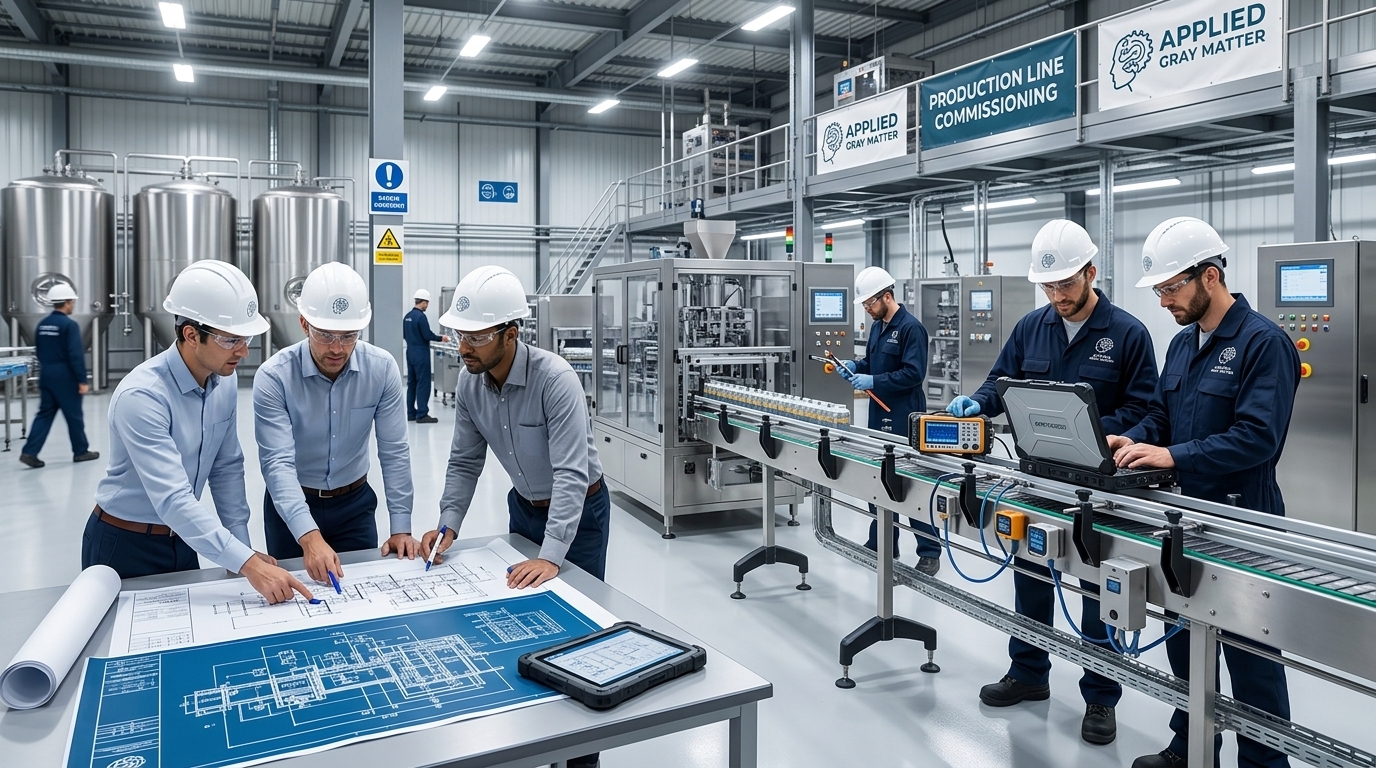
A properly commissioned line is proven against the operating envelope it will actually see — not a demo recipe. That envelope includes worst-case feedstock variance, worst-case ambient conditions, planned changeover sequences, and the full alarm-response matrix. This is the framework we run:
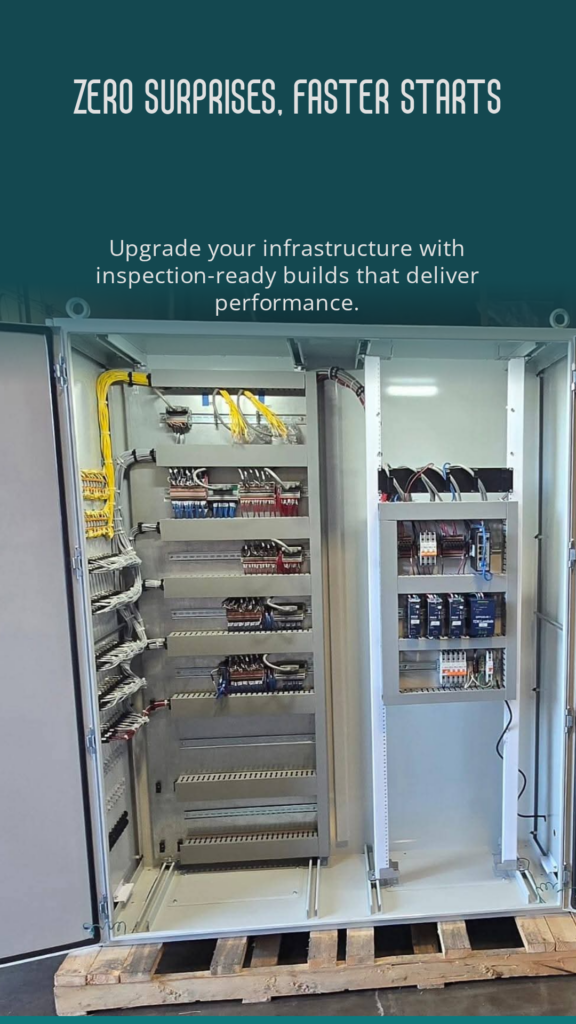
Static verification of every I/O point, every interlock, every safety circuit. Done at the integrator’s floor, on the actual panels we build in our UL508A shop, before the equipment ever ships.
The same tests, repeated after installation, plus utility verification: air, water, power, network, safety-rated fieldbus. This is where site-specific power quality issues surface. If Level 2 is skipped or shortened, expect month-three faults.
Multi-machine sequences under realistic upstream and downstream loads. This catches the classes of fault that only appear when the whole line is running — buffer starvation, downstream back-pressure, MES/SCADA handshake races.
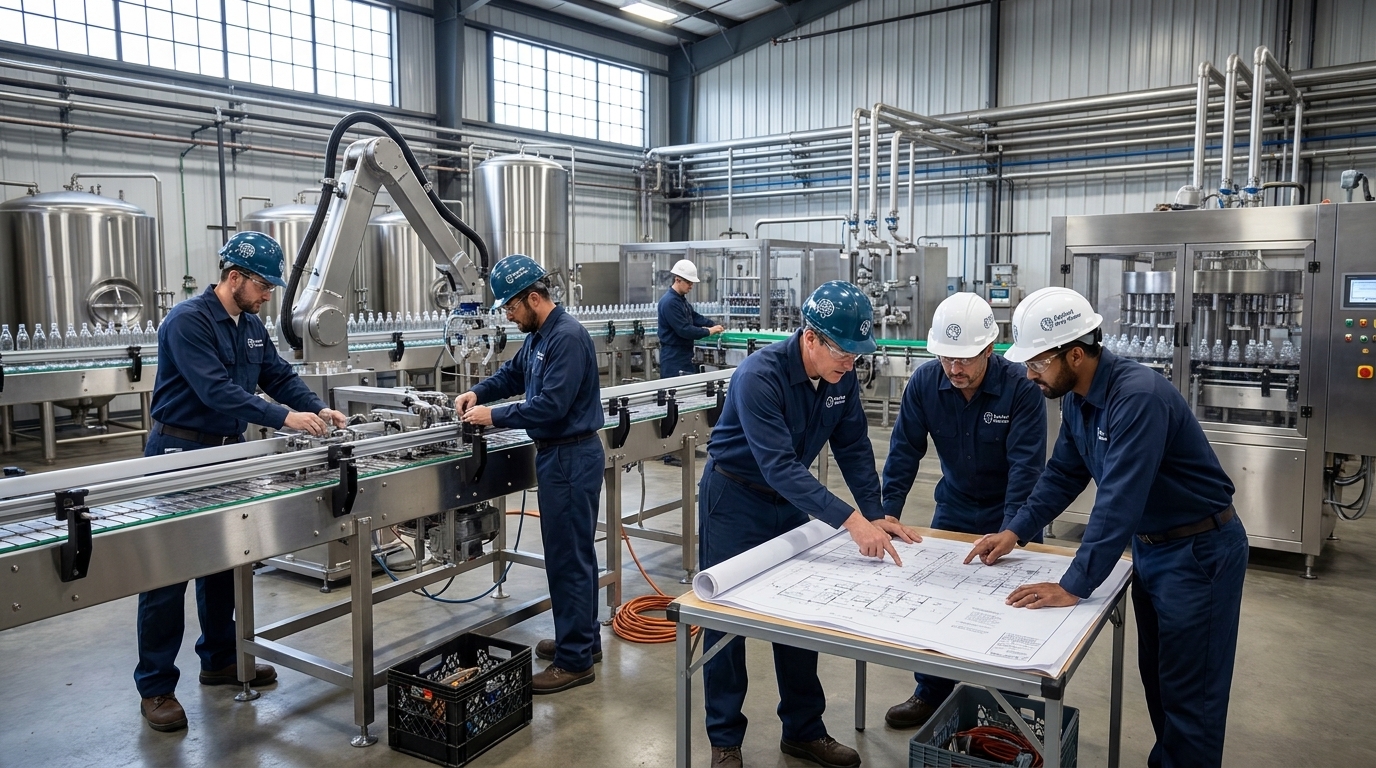
Sustained-rate proof over a defined production window with the actual product mix. Availability, performance, and quality all measured against contract — the same OEE components that every maintenance analytics vendor ultimately measures against. If the line cannot hit these targets under commissioning conditions, it will not hit them in steady state.
Documented standard work, alarm-response procedures, and a version-controlled program of record delivered to the customer’s maintenance team. This is where most commissioning projects fail quietly — the equipment works, but the people who now own it have no way to keep it that way.
The commissioning question we ask every OEM and every plant owner is the same: “If your best maintenance tech quit tomorrow, could this line still run at rate next month?” If the answer is no, the line is not commissioned. It’s just running.
There is a specific pattern of field-service engagement that consistently increases mean time to repair: dispatching a technician with generic training, generic parts, and no pre-arrival diagnostic. Competitors’ service pages promise 24/7 dispatch (Premier Automation, Quad Plus) — which is table stakes, not a differentiator. What actually shortens MTTR is the pre-arrival phase.
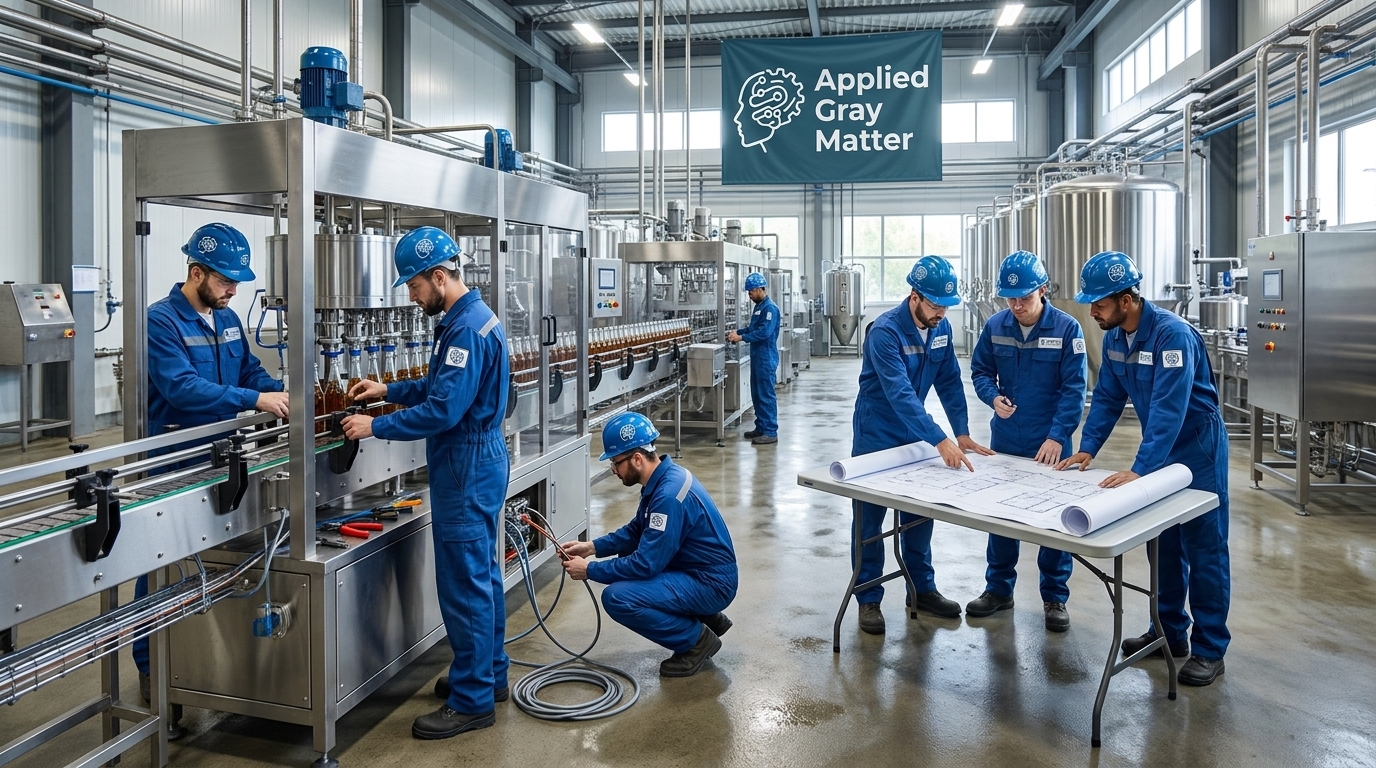
The tooling market — Tractian, Augury, L2L, and others — is right that predictive maintenance beats reactive. What their pages don’t say is that predictive maintenance only works when the underlying control system is instrumented to produce clean signals. A vibration sensor bolted to a machine whose motor current is noisy from a poor VFD install produces false positives, and false positives train your team to ignore alerts. The upstream fix — controls done right — has to precede the analytics layer, not follow it.
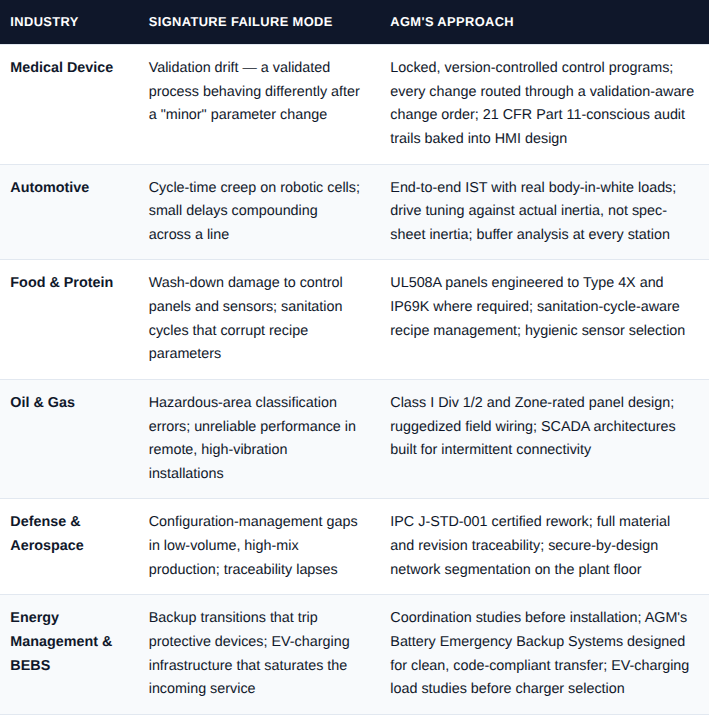
Applied Gray Matter’s engineers have spent careers inside the industries listed on our About page: energy management, medical device manufacturing, automotive production, industrial food and protein, oil and gas, defense, and aerospace. Each has a signature failure mode. Recognizing the signature is 80% of the fix.
Data-center construction is the most capacity-constrained sector in the global construction market right now, per Data Center Knowledge. Alphabet, Amazon, Microsoft, and Meta collectively planned over $350 billion in data-center capex for 2025, with projections above $400B for 2026 (Terrapin). McKinsey projects total data-center demand nearly tripling by 2030 (Programs.com summary), with AI-optimized servers accounting for 64% of new power needs by decade’s end (Avid Solutions).

The bottleneck in that build-out is not concrete. It is the controls and commissioning engineering that turns a shell full of switchgear into a certified, redundant, five-nines facility. iRecruit’s 2026 outlook flags power, cooling, controls, and automation specialists as the toughest commissioning roles to fill through 2026. That’s exactly the skill stack Applied Gray Matter has been building for decades on industrial floors.
Why this matters for AGM’s partners
The engineering skill that keeps a medical-device line at 99.5% availability is the same skill that keeps a data-center hall at 99.999%. The certifications overlap. The commissioning framework overlaps. The version-controlled discipline overlaps. Operators building or expanding data centers in 2026–2030 are not looking for a new type of engineer — they are looking for the type of engineer who has already been solving these problems for the industries AGM serves.
Applied Gray Matter is not a parts supplier and not a body shop. We are a UL508A panel manufacturer and industrial controls engineering firm whose leadership has spent decades inside the industries that cannot tolerate downtime — energy management, medical device manufacturing, automotive production, industrial food and protein, oil and gas, defense, aerospace, and now data-center infrastructure.
The AGM engineering bench: Rock Grbic, Director of Engineering, brings 20+ years designing, troubleshooting, and optimizing electronic and electro-mechanical systems; UL508A MTR, NFPA 70, and IPC J-STD-001 certified. Vince Cianchetta, Director of Operations, has been a systems integrator across food & protein, oil & gas, energy management, medical device, defense, and automotive since 2002, following senior technology roles dating to the early 1990s. Kevin McDaniel, Managing Director, has built and sold multiple companies in construction and factory automation. Together they lead an engineering practice that has delivered for Fortune 500 clients and specialized OEMs alike. Full team background: appliedgraymatter.com/about.
What partnering with AGM looks like in practice:
Every one of those service lines is delivered by the same engineering discipline: preserve the evidence, verify the environment, fix the cause, document the change. We do not ship undocumented work. We do not close tickets we cannot explain. And we do not walk off a site until your team can run the line without us.
Experienced UL 508A Control Panel Fabrication, Ready When Your Plant Can’t Wait When a control panel fails, an automated line...
By Rock Grbic, Director of Engineering, Applied Gray Matter — UL 508A MTR, NFPA 70, IPC J-STD-001 certified. Serving Fortune...
Our team at Applied Gray Matter is ready to collaborate with you to create optimal custom controls for any OEM application. Call Us (315) 878-2372 or click ‘Schedule a Consultation’ to get started.